



Open a hive during spring comb-building season and you might catch one of the strangest, most beautiful sights in beekeeping: a curtain of bees hanging leg-to-leg between the frames, swaying gently like a living lace doily. That’s festooning, well, almost. (We don’t use the dash here, but you get the idea.) Festooning is what happens when honey bees link their bodies into chains and curtains inside the hive, and it’s one of those behaviors that beekeepers love to watch and scientists are still trying to fully explain.
Here’s what we know, what we suspect, and what to look for the next time you peek inside a frame.
What Is Festooning in Bees?
Festooning is when worker honey bees link their feet together to form hanging chains or curtains between the frames of the hive. Picture a single layer of bees, each gripping the legs of the next, stretched across an open space like a swag of garland. That’s a festoon.
The chains can be just one bee wide or stretch nearly the full width of a frame. They’re almost always only one bee deep, giving them that airy, lace-like look beekeepers know and love. You’ll spot festooning most often in spring and early summer, when colonies are building new comb at full speed.

Why Do Bees Festoon? The Leading Theories
Here’s the honest answer: nobody is completely sure. Festooning has been studied for decades, and the working theories are educated guesses based on careful observation. Most beekeepers and researchers agree on a handful of likely explanations, and the truth is probably that festooning serves more than one purpose at once.
1. A Living Scaffold for Comb Building
The most popular theory is that festooning bees act as scaffolding. When workers need to build new wax comb in an open space, hanging in a chain gives them a stable framework to work from. The bees in the chain release tiny wax flakes from glands on their abdomens, pass them up to other workers, and shape them into the hexagonal cells you recognize as honeycomb. If you’ve ever wondered where beeswax comes from, this is the moment it happens.

2. Measuring Space Inside the Hive
Another popular theory: festooning helps bees measure distance. Honey bees are incredibly precise architects, and they maintain a consistent gap of about 3/8 of an inch between combs known as bee space. By hanging in a chain across an empty gap, bees may be checking the dimensions before they start building. Think of it as a living measuring tape made of bees.
3. Generating Heat for Wax Production
Beeswax doesn’t flow until temperatures reach somewhere around 91°F. Some beekeepers believe that festooning bees pack close together to raise the local temperature inside the hive, making it easier for the bees who are actively producing wax to shape and manipulate it. The proximity of so many bee bodies may also help share wax flakes from one worker to another.
4. Communication and Coordination
Bees are constantly passing information through touch, pheromones, and antennae contact. Festooning chains may serve as a kind of communication network, letting bees coordinate where comb gets built, how fast, and where workers are needed next. It’s less proven than the other theories, but it lines up with everything else we know about how colonies operate as a single coordinated organism.
How a Festoon Forms: The Mechanics
Worker bees do all the festooning. They use small hooks on the ends of their legs to grip onto the legs of the bee next to them, which is how a single chain holds its shape even when it’s several inches long. Workers of all ages participate, though bees with active wax glands (typically about 12 to 18 days old) seem to show up most.
When you separate two frames gently during an inspection, you can often see the bees stretching between them, holding on as long as they can before finally letting go. The chains can range from a few bees to a curtain spanning most of the frame.
A Quick Note: Festooning Is Not the Same as Clustering or Bearding
It’s easy to mix these behaviors up because all three involve groups of bees hanging together. Here’s the difference:
- Festooning happens inside the hive, usually between frames, and is one bee deep. It’s tied to comb building.
- Clustering is what bees do to keep warm. In winter, they form a tight ball around the queen to share body heat and conserve energy.
- Bearding happens outside the hive on hot summer days, when bees pile up on the front of the hive in a thick, multi-layered mass to cool the interior and improve airflow.
That said, festooning can be loosely connected to swarming behavior. A colony that’s actively festooning is often a colony that’s expanding, building comb at full speed, and possibly running out of room. Tight quarters are one of the conditions that trigger a swarm.

What Festooning Tells a Beekeeper
Watching for festooning is one of those small skills that separates curious hobbyists from observant beekeepers. When you see active festoons during an inspection, here’s what it usually means:
- The colony is healthy and expanding. Festooning takes energy and lots of bees, so it’s a sign of a strong, growing population.
- Comb building is underway. Especially in spring, festoons signal that bees are drawing out new comb or repairing damage.
- You may need to add space soon. Aggressive festooning during peak season can be an early hint that the colony is getting cramped and may benefit from another super or brood box.
- You’ve got something worth slowing down to watch. Honestly, that’s reason enough.

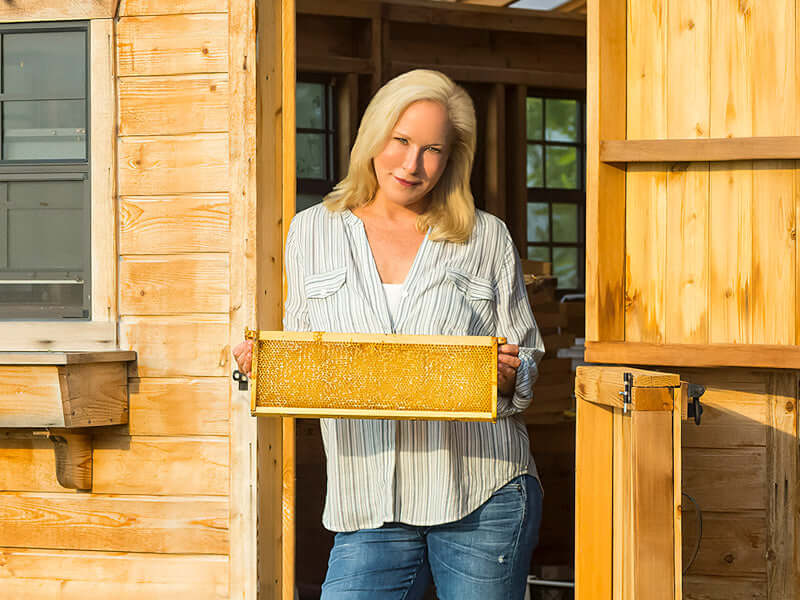
Kara Brown tends bees on her 102-acre Chesterhaven Beach Farm on Maryland’s Eastern Shore.
How to See Festooning During a Hive Inspection
Festooning is easiest to spot during the warmer parts of the day in spring and early summer, when bees are actively building. If you want to catch it in action, here’s how to give yourself the best chance:
Inspect During Warm, Calm Weather
Plan your hive inspections for mid-morning or early afternoon, when temperatures are comfortable and many of the older foragers are out collecting nectar. The bees still inside the hive will be calmer, and you’ll have a clearer view of what’s happening between frames.
Use Smoke Lightly
A gentle puff of smoke at the entrance calms the colony before you open it up. Heavy smoke can disrupt the festoons and send bees scattering, so go light.
Lift Frames Slowly
This is where the magic happens. When you slowly pull two frames apart, you’ll often see festooning bees stretching between them like wires across power poles. Move gently. The festoons will break naturally as you separate the frames, but a slow lift gives you a few seconds to actually see the structure before it falls apart.
Pay Attention to Where and How Often
Note which frames have the most festooning, how often you see it across inspections, and how it changes through the season. A consistent uptick in festooning during peak nectar flow is a strong signal that your colony is building hard and may need more space soon.

Festooning in Wild Bee Colonies
Festooning isn’t a behavior bees learned from beekeepers. It happens just as readily in wild colonies, which suggests it’s deeply rooted in honey bee biology. German bee biologist Jürgen Tautz has proposed that festooning may be an inherited carryover from wild bees that build combs inside tree hollows. Cape honey bees in southern Africa also festoon, and observers have noted their behavior closely tied to wax production.
Wild colonies often build irregular, organic comb shapes that follow the contours of whatever cavity they’ve moved into. Festooning helps them coordinate that construction across uneven surfaces, and they also use it when repairing damaged sections of comb. It’s a reminder that the elegant, parallel comb you see in a managed hive is a slightly tidier version of what bees do naturally in the wild.

Why Festooning Matters
Festooning is a small window into something much bigger: the extraordinary coordination of a honey bee colony. A hive of 50,000 bees has no manager. No bee is in charge of telling the rest where to build, when to start, or how wide to make the comb. And yet, working together, they produce some of the most mathematically precise architecture in nature.
Festooning is one of the visible signs of that invisible coordination. It’s also one of the things that makes beekeeping endlessly interesting. The longer you keep bees, the more you realize how much there is still to learn, and how much of what bees do is still a beautiful mystery.
If you want to bring a piece of that wonder home, our raw honeycomb is honey sealed exactly the way the bees finished it: built by these same festooning workers, capped in wax, and never extracted. It’s the closest you can get to tasting the inside of a hive.

Festooning FAQs
What does festooning mean in bees?
Festooning is when honey bees link their legs together to form hanging chains or curtains between the frames of a hive. The behavior is typically tied to comb building and most often seen in spring and early summer.
Why do bees festoon?
The leading theories are that festooning provides a living scaffold for comb construction, helps bees measure space inside the hive, generates heat for wax production, and supports communication between workers. Most likely, it serves several of these purposes at once.
When can I see festooning in my hive?
You’re most likely to see festooning during warm-weather inspections in spring and early summer, when bees are actively drawing new comb. Lift two frames apart slowly and look between them for chains of bees gripping leg-to-leg.
Is festooning a sign of a healthy hive?
Generally, yes. Active festooning means the colony has enough bees and energy to build new comb, which is a sign of a strong, expanding population. It can also signal that the colony may soon need more space.
What is the difference between festooning and bearding?
Festooning happens inside the hive in airy single-layer chains, usually tied to comb building. Bearding happens outside the hive on hot days, when bees pile up in a dense, multi-layered mass on the front of the hive to cool the interior.
Do wild bees festoon?
Yes. Festooning has been observed in both managed and wild honey bee colonies, and many researchers believe the behavior is an inherited trait that bees brought with them from natural cavity nests.
How long does festooning last?
A festoon can hold its shape for hours as bees work on comb construction nearby. The chains naturally break apart when frames are separated during inspection or when the building work in that section is complete.
The Wrap on Festooning
Festooning is one of those bee behaviors that you can’t look at without smiling. Living chains of bees, organized without a leader, building wax architecture that has been perfected over millions of years. The next time you open a hive in spring, lift a frame slowly. If you’re lucky, you’ll catch a glimpse of festooning in action and a brief look at one of nature’s quietest engineering marvels.

Caring for this land and these communities is at the core of who we are. It’s why we created Roots & Wings, our giving initiative that connects every purchase to something that matters. See how we give back.