

Most people assume beeswax is a plant product, something pressed from seeds or refined in a factory. It isn’t. Beeswax is made entirely by honeybees, secreted from glands on the underside of a young worker bee’s abdomen and shaped, flake by flake, into the hexagonal cells of the honeycomb. It is one of the more remarkable materials in nature: built by insects, chemically complex, and useful across a surprising range of everyday products.
This guide covers where beeswax actually comes from, the biology, what happens inside the hive, and what beeswax is made of. If you want to know what to do with beeswax once you have a block of it, we cover that in our guide to beeswax uses around the home. For turning raw cappings into clean, usable wax, see our posts on processing beeswax and filtering beeswax.
How Do Bees Make Beeswax?
Beeswax is made by young female worker bees, and only during a specific stretch of their short lives. Worker bees have eight wax-producing glands on the underside of their abdomens. These glands are most productive when the bee is roughly twelve to eighteen days old. After that window closes, the glands wind down and the bee moves on to other jobs in the colony, foraging, guarding, tending brood.
The process starts with food. Worker bees eat honey, and the sugars in it fuel wax production. Through digestion, those sugars are converted into wax, which emerges from the glands as tiny, translucent scales, thin flakes about the size of a pinhead that harden the moment they hit the air. The fresh scales look almost glassy and clear, and only turn opaque once the bees start working them.

Young worker bees make beeswax by secreting it from special wax glands on their abdomen
From there it becomes a group effort. Bees collect the scales with their legs and chew them with their mandibles, softening the wax with warmth and saliva until it is pliable enough to shape. For this to work, the cluster keeps the building area warm, around 95 degrees Fahrenheit, because beeswax has to be warm to be workable. The softened wax is then pressed into the precise six-sided cells that make up the comb.
While they build, bees often link legs and hang together in living chains, passing and shaping wax as they go. This behavior is called festooning, and watching it is one of the small wonders of beekeeping. The comb that results is something no single bee could build alone, the whole colony effectively works as one organism.
Making wax is expensive work. It takes roughly six to eight pounds of honey for bees to produce a single pound of beeswax, which is exactly why bees build carefully and reuse comb whenever they can. They only stockpile surplus, and a healthy colony always keeps enough to carry itself forward.

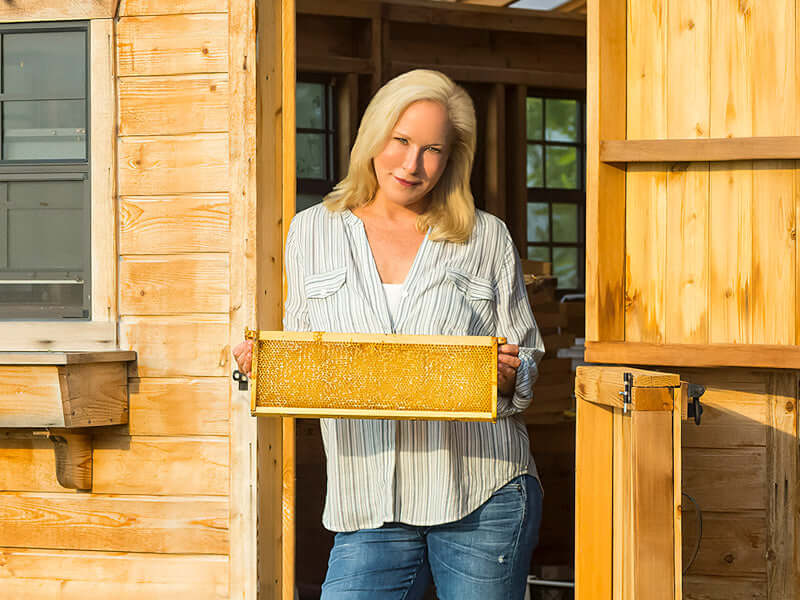
Our honeycomb contains beeswax in its natural, unprocessed form, honey and wax exactly as the bees made it
What Beeswax Does Inside the Hive
Beeswax is the structural backbone of the hive. The honeycomb it forms does three jobs at once: it is a nursery for developing brood, a pantry for pollen, and a vault for ripened honey. That hexagonal cell shape isn’t decorative either. It is one of the most material-efficient structures in nature, holding the most volume with the least wax, which matters a great deal when every ounce of wax costs the colony pounds of honey to make.
Once a cell is full of finished honey, the bees seal it with a fresh cap of beeswax to lock out moisture and air. Those caps, the cappings, are what beekeepers slice off at harvest, and they are the main source of the beeswax collected from a hive. Because cappings wax is brand new and has never held brood, it is the cleanest and palest wax the colony makes.
Wax also does quiet maintenance work. If a frame warps or a gap opens up, workers patch it with wax to keep the hive sealed and stable. A colony’s knack for holding steady temperature and humidity depends in part on this constant small repair.
Color tells you a lot about a piece of wax. Fresh cappings run pale yellow to nearly white. Older brood comb darkens over time, drifting toward brown or grayish-green as it takes on cocoon silk, propolis, and the general wear of hive life. As a rule, lighter wax is younger and cleaner, darker wax is older and has seen more use.

What Is Beeswax Made Of?
Beeswax is not one substance but a blend of hundreds of natural compounds, mostly esters, fatty acids, and long-chain alcohols. The single largest component is a wax ester called triacontanyl palmitate, alongside a family of related esters and free fatty acids. That mix is what gives beeswax its firmness at room temperature and its smooth, workable softness once warmed.
Beeswax melts at a fairly low temperature, roughly 144 to 147 degrees Fahrenheit (62 to 64 degrees Celsius), so it turns liquid over gentle heat but stays solid in a warm room. It doesn’t dissolve in water, it’s chemically stable, and it resists going rancid, which is a big part of why it lasts for years and shows up in everything from candles to cosmetics to wood finishes.
The exact makeup of any batch shifts a little depending on the bees that made it, what they were foraging, and the climate and region of the hive. That’s why wax from different species or different parts of the world can behave a little differently, even when it looks similar in the block.
One thing worth knowing if you ever buy beeswax: it is commonly cut with cheaper materials in the commercial supply chain, things like paraffin or plant waxes, which change how it looks, smells, and performs. Pure beeswax has a soft, faintly honey-like scent and an even golden color. Wax that smells of nothing, or looks oddly uniform, is often blended. If you’re sourcing it for candles or cosmetics, purity is worth paying attention to.
From the Hive to Your Hands
Beeswax starts as a flake of wax from a young worker bee, becomes the architecture of one of nature’s most efficient structures, and eventually ends up as lip balm, a candle, a furniture polish, or a block on a maker’s bench. The trip from comb to finished product runs through harvesting, processing, and filtering, and each of those steps has its own quirks worth understanding.
For ideas on putting a block of wax to work, see our full guide to beeswax uses around the home. For the hands-on steps of turning raw cappings into clean wax, start with how to process beeswax, then read our notes on filtering beeswax, including what we learned the hard way with commercial equipment. And if you want to taste beeswax the way the bees intended, in its most natural form, our raw honeycomb is honey and wax together, straight from the hive.
FAQs About Beeswax
Where does beeswax come from?
Beeswax comes from honeybees. Young female worker bees secrete it as tiny scales from eight wax glands on the underside of their abdomens, then chew and shape those scales into the hexagonal cells of the honeycomb. It is an animal-made wax, not a plant product.
How do bees make beeswax?
Worker bees eat honey, and their bodies convert the sugars into wax that emerges from abdominal glands as thin, translucent flakes. Other bees collect those flakes, soften them by chewing and warmth, and press them into comb. The hive stays around 95 degrees Fahrenheit so the wax remains workable.
Do all bees make beeswax?
No. Only young female worker honeybees make beeswax, and only during a window of roughly twelve to eighteen days of age, when their wax glands are most productive. After that the glands wind down and the bee takes on other roles in the colony.
How much honey does it take to make beeswax?
It takes roughly six to eight pounds of honey for bees to produce a single pound of beeswax. Because wax is so costly to make, bees build comb carefully and reuse it whenever they can.
What is beeswax made of?
Beeswax is a natural blend of hundreds of compounds, mainly esters, fatty acids, and long-chain alcohols, with a wax ester called triacontanyl palmitate as the largest single component. This mix gives beeswax its firmness at room temperature and its low melting point of about 144 to 147 degrees Fahrenheit.
Why is some beeswax darker than others?
Color reflects age and use. Fresh cappings wax is pale yellow to near-white because it has never held brood. Older brood comb darkens to brown or grayish-green as it absorbs cocoon silk, propolis, and debris over time. Lighter wax is generally younger and cleaner.
Caring for this land and these communities is at the core of who we are. It’s why we created Roots & Wings, our giving initiative that connects every purchase to something that matters. See how we give back.

Updated 6/17/2026