

Telling the bees is an old beekeeping tradition in which the keeper shares major life events, births, marriages, and especially deaths, with the hive. For centuries, families across Western Europe and early America believed that a hive left out of the loop might stop making honey, fall ill, or leave altogether. As a beekeeper, I find it one of the loveliest customs ever attached to this craft, and its story runs from Celtic legend all the way to Buckingham Palace.

What Is Telling the Bees?
Telling the bees is the practice of formally informing a bee colony about important events in the beekeeper’s household. The custom was recorded across England, Ireland, Wales, France, Germany, Switzerland, the Netherlands, Bohemia, and parts of the United States, particularly New England.
The heart of the belief was simple: bees were considered members of the family. Treat them as such, keep them informed, and the hive would stay content and productive. Forget them, and the bees might take offense. This wasn’t a casual superstition tacked onto beekeeping. In households that depended on honey and beeswax, keeping the bees “in the know” was treated as genuine hive management.

There’s a special word for when bees hold hands: festooning!
Where the Tradition Came From
Nobody knows exactly where telling the bees began. Its roots are old enough that the origin has been lost, though folklorists point to a few likely sources.
Bees as Messengers Between Worlds
In Celtic mythology, bees were regarded as messengers between our world and the spirit realm. A bee lingering near someone’s head was read as an omen, and when a person died, the bees were believed to sense the soul leaving the house. Some scholars also point further back, to ancient Aegean and Egyptian ideas connecting bees with the afterlife, though those links are speculative. Bees carry sacred meaning in traditions all over the world, something we explore in our post on honey in religions around the world.
A Victorian Revival
The custom appears most strongly in written records from the 18th and 19th centuries. The Victorian era brought a renewed fascination with folklore and the natural world, and beekeeping was still an everyday household craft. Writers and folklorists of the period collected accounts of the practice from rural communities, which is how so many regional details survived. For more on how deeply honey is woven into human history, wander through our history of honey.
How Beekeepers Told the Bees
The rituals varied by region and by family, but most versions shared a few common threads: approach the hive gently, knock softly to get the colony’s attention, and deliver the news in a calm, quiet voice.

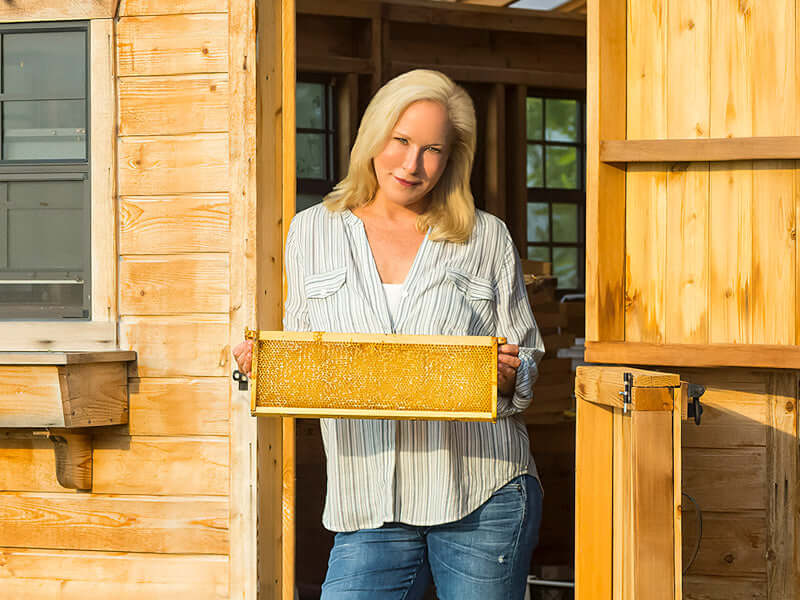
Kara loves spending time with her bees on the farm
In Times of Mourning
Death was the event the bees most needed to hear about. When a keeper or a member of the household died, someone would go to the hives, knock gently, and announce the loss. In Britain and New England, hives were often draped in black crepe or cloth so the bees could be “put into mourning” along with the family. In some accounts, funeral biscuits or a portion of the funeral food was left beside the hive so the bees could share in the observance.
When the beekeeper themselves passed, the bees also needed an introduction to their new keeper, a formal changing of the guard so the colony would accept its new master or mistress.
In Times of Celebration
Happy news counted too. Weddings, in particular, came with their own customs. In some parts of England, a slice of wedding cake was left beside the hive. In Brittany, tradition held that hives should be decorated with scarlet cloth at a wedding so the bees could take part in the rejoicing. In Westphalia, Germany, newlyweds were expected to introduce themselves to the bees on the way to their new home, or their married life would be unlucky.
Regional Variations
The tradition traveled and adapted. European immigrants carried it to New England and Appalachia, where draping the hives in mourning cloth persisted for generations. In Bohemia, the 1855 novel Babička by Božena Němcová closes with the grandmother asking that the bees be told of her death so they will not die out, a detail drawn from the author’s own folklore research. Family to family and village to village, the details shifted, but the underlying idea held steady: the bees deserved to know.

This bee is pollinating a blueberry blossom
What Happens If You Don’t Tell the Bees?
According to the folklore, the consequences were serious. An uninformed hive might stop producing honey, sicken, abandon the hive, or die out entirely, and the bad luck could extend to the family as well.
One well-documented account from Norfolk, England tells of a family who bought a hive at auction from a farmer who had recently died. The bees seemed sickly and unlikely to thrive, and the new owners concluded it was because the colony had never been put into mourning for its late master. They tied a piece of black crepe to a stick, attached it to the hive, and the bees were said to have recovered, an outcome the family attributed entirely to the overdue courtesy.
Modern beekeepers know that colonies leave hives for very different reasons, from overcrowding to environmental stress. If you’re curious about the science behind a colony packing up and moving out, we cover it in why bees swarm.
The Telling the Bees Poem
The tradition owes much of its fame to the New England Quaker poet John Greenleaf Whittier, whose 1858 poem “Telling the Bees” appeared in The Atlantic. In it, a man returns to his beloved Mary’s home after a year away and realizes, from the actions of a young servant girl at the hives, that the house is in mourning:
“Before them, under the garden wall,
Forward and back,
Went drearily singing the chore-girl small,
Draping each hive with a shred of black.”
The girl’s song delivers the news to the bees, and to the reader: “Stay at home, pretty bees, fly not hence! Mistress Mary is dead and gone!”
Whittier included a note explaining the custom when the poem was published, a hint that even by the mid-1800s, the tradition was already fading from common memory. The practice has since inspired poems by Deborah Digges, Eugene Field, Carol Frost, and others.
The Royal Beekeeper and Queen Elizabeth II
The tradition made international headlines in September 2022, after the death of Queen Elizabeth II. John Chapple, the royal beekeeper, visited the hives at Buckingham Palace and Clarence House to inform the bees that their mistress had died and that a new master, King Charles III, would care for them. He described knocking on each hive and gently asking the bees not to go.
It was a remarkable moment: an ancient piece of folklore, performed in earnest at a royal palace, covered by news outlets around the world. For many people, it was the first time they had ever heard of telling the bees.

Is There Any Science Behind It?
There’s no scientific evidence that bees understand human speech or need to be told the news. But the folklore isn’t entirely detached from real bee biology, because honey bees genuinely are remarkably perceptive creatures.
Research has shown that honey bees can learn to recognize human faces, associate sights and smells with experiences, and remember landmarks with impressive accuracy. They’re highly sensitive to vibrations, which matters inside a dark hive where much of their communication happens through movement. Their famous waggle dance conveys detailed information about the direction, distance, and quality of food sources. We share more of these wonders in our roundup of honey bee myths, lore, and facts.
There’s also a practical grain of truth buried in the ritual itself. Approaching a hive slowly, tapping gently, and speaking in a calm voice is simply good beekeeping. Families who made a habit of quiet, deliberate visits to their hives were, whether they knew it or not, handling their bees well. Folklore often grows around a kernel of sound practice.

Telling the Bees Today
The tradition declined as industrial agriculture replaced backyard beekeeping and families moved off the land. Fewer households kept hives, and the intimate, daily relationship between a family and its bees became rare.
Yet the custom never fully disappeared. Some beekeepers still tell their bees, some in earnest, some as a fond nod to the keepers who came before them. I’ll admit I talk to my bees constantly at Chesterhaven Beach Farm. They hear about the weather, the state of the wildflowers, and whatever else is on my mind. They keep my secrets and never talk back.
Whether or not the bees are listening, the ritual expresses something real: respect for the colony and gratitude for what bees give us. They pollinate our crops, sustain ecosystems, and turn nectar into every jar of Eastern Shore honey we harvest. A colony even has lessons to teach us about how we live and work together, which is a thread we pull on in our post about hive mentality.

Keep This Tradition Alive
Telling the bees is folklore, not science, and that’s exactly why it endures. It comes from a time when people lived close enough to their bees to consider them family, and it survives because that closeness is worth remembering. From Celtic legend to Whittier’s poem to the hives of Buckingham Palace, the custom carries a single, gentle message: the bees deserve our attention and our care.
So if something big happens in your life and you happen to pass a hive, feel free to lean in and share the news. The bees may not understand a word, but you’ll be keeping a very old promise.


FAQs About Telling the Bees
What is the tradition of telling the bees?
Telling the bees is a folklore tradition in which beekeepers inform their hives of major life events such as births, marriages, and deaths. Bees were considered part of the family, and keeping them informed was believed to protect the harmony and productivity of the hive.
What happens if you don’t tell the bees?
According to the folklore, a hive left uninformed of a death might stop producing honey, fall ill, abandon the hive, or die out. One documented account from Norfolk, England describes sickly bees recovering only after their new owners draped the hive in black crepe to put them into mourning.
Where did telling the bees originate?
The exact origin is unknown. Folklorists often point to Celtic mythology, where bees were seen as messengers between the living and the spirit world. The custom is best documented in 18th and 19th century Western Europe and New England.
Who wrote the poem “Telling the Bees”?
John Greenleaf Whittier, a New England Quaker poet, published “Telling the Bees” in The Atlantic in 1858. The poem describes a chore girl draping hives with black cloth and singing to the bees that their mistress has died.
Did the royal beekeeper tell the bees when Queen Elizabeth II died?
Yes. In September 2022, royal beekeeper John Chapple informed the bees at Buckingham Palace and Clarence House of the Queen’s death, knocking gently on each hive and reassuring the bees that their new master would care for them.
Do beekeepers still tell the bees today?
Some do. While the custom declined with industrialization, many modern beekeepers still speak to their bees, either as a sincere ritual or as a fond nod to tradition, and as a way of expressing respect for the colony.