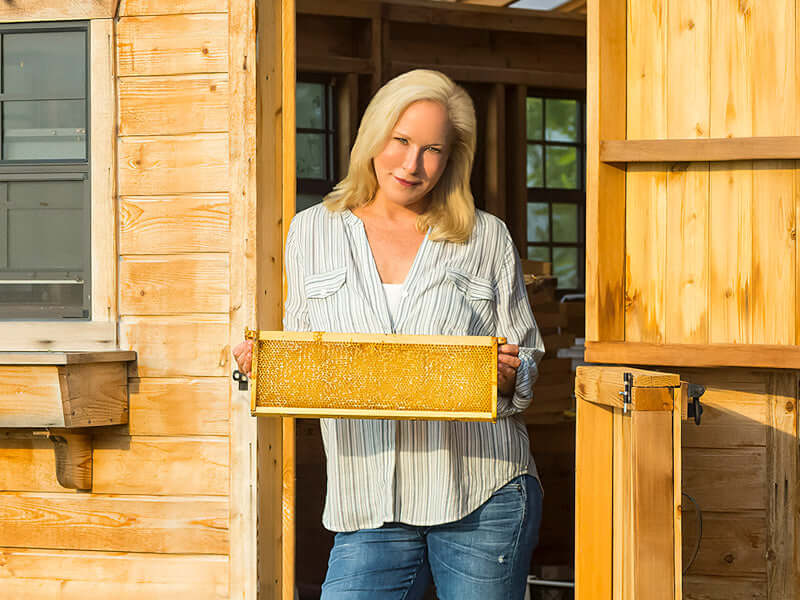


Bees are remarkable builders. Beyond their role in pollination, they construct comb with a precision that has shaped how every modern hive is designed. The principle behind that precision is called bee space, and once you understand it, a lot of what happens inside a hive starts to make sense, from why frames lift out cleanly to why bees keep gluing things you wish they wouldn’t.
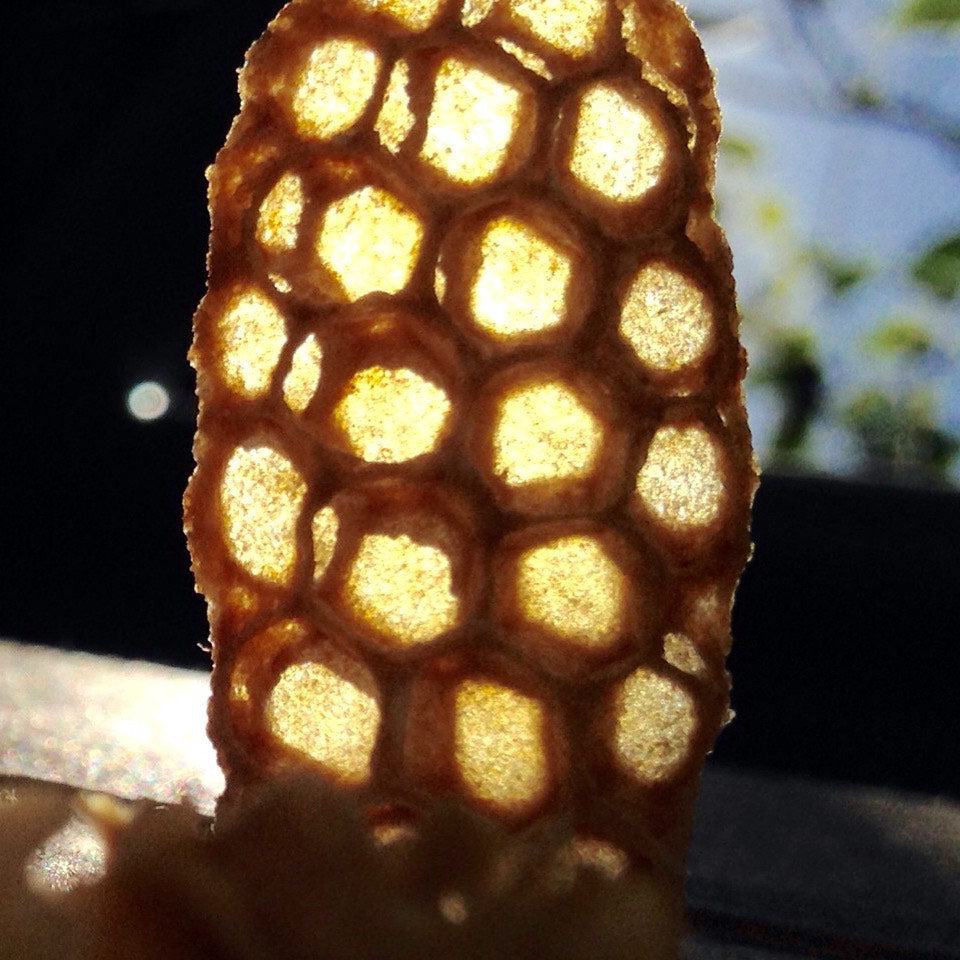
Burr comb backlit by window light. Photo by Geof Graham.
What Is Bee Space?
Bee space is the precise gap honey bees naturally leave open inside a hive so they can move and work without obstruction. Worker bees treat any gap within this range as a corridor and keep it clear. Make the gap too big and they fill it with comb. Make it too small and they seal it with propolis, the sticky resin they gather from trees.
The accepted range is roughly one quarter inch to three eighths inch (about 6 to 9 mm), with around five sixteenths inch (8 mm) considered the sweet spot most beekeepers design around. That single measurement is what makes a hive manageable: it lets every frame lift out for inspection without tearing comb or prying apart a wall of glue.
For beekeepers, bee space is more than a piece of insect trivia. It is the blueprint behind nearly every decision about hive equipment. For the artistically inclined, it can also be fun to simply see what bees do with an open space.

Kara and her crew during harvest. Photo by Kirsten Elstner.
Why Bee Space Matters
Respecting bee space is what separates a hive you can work from one that fights you at every inspection. When frame spacing matches what bees would build in the wild, they leave the gaps open and you can pull frames freely. When the spacing is off, even by a little, the bees go to work closing it, which is where most management headaches begin.
This is also the principle that made non-destructive beekeeping possible in the first place. Before movable frames, harvesting honey often meant cutting out fixed comb and destroying much of the colony in the process. Designing the hive around bee space changed that, letting beekeepers inspect, manage, and harvest while keeping the colony intact. If you are still gathering your equipment, our guide to setting up your first hives walks through the boxes and frames that put this principle to work.

A bee on a Langstroth frame, with the gap of bee space visible between frames.
What Is Burr Comb?
Burr comb is the extra comb bees build to close a gap that falls outside bee space. It might look harmless, but it creates real problems during inspections. If frames are misaligned or spaced too far apart, bees will instinctively bridge even a small gap with comb, gluing frames to each other or to the box.
Why Do Honey Bees Build Burr Comb?
A hive ends up with burr comb when something disrupts the spacing the bees expect. Common causes include:
- The gap between frames or boxes is larger than bee space, so the bees fill it in.
- Frames are pushed unevenly to one side, leaving a wide gap on the other.
- Equipment from different sources is mixed together, creating gaps that don’t line up.
- A frame is missing, warped, or the wrong size, throwing off the spacing of everything around it.
It does not take much. A gap only slightly wider than three eighths of an inch is enough to invite comb. The bees watching that festoon of wax-builders stretch across a gap are reading the space far more precisely than our eyes can. (Curious about that behavior? See our piece on festooning and how bees measure space.)

An inner cover filled with burr comb.
Creative Uses for Burr Comb
Before you toss that scraped-off burr comb, hold onto it. Once cleaned and melted down, beeswax is one of the most versatile materials in the hive. A few favorites:
- Candle making
- Shoe and furniture polish
- Crayons
- Skin balms and salves
In my own experience, fitting new equipment alongside my existing setup revealed small mismatches that the bees promptly filled with burr comb. They are meticulous about their living space, and any imbalance pushes them to take action. If you collect enough of it, our full guide to what to do with beeswax covers how to put those scraps to work.

Kara doing a hive inspection at Chesterhaven Beach Farm.
Preventing and Managing Burr Comb
The rule of thumb is simple: remove burr comb when you spot it, then fix the gap that prompted the bees to build it. Squaring up frame spacing and seating frames evenly keeps the comb from coming back. Staying on top of it is part of keeping the hive easy to open and the frames easy to lift.
Left unchecked, heavy burr comb makes frames hard to remove, and a hive left open too long during a working inspection can attract robber bees from other colonies looking for an easy meal. Working efficiently, especially during a strong nectar flow, helps you avoid that.
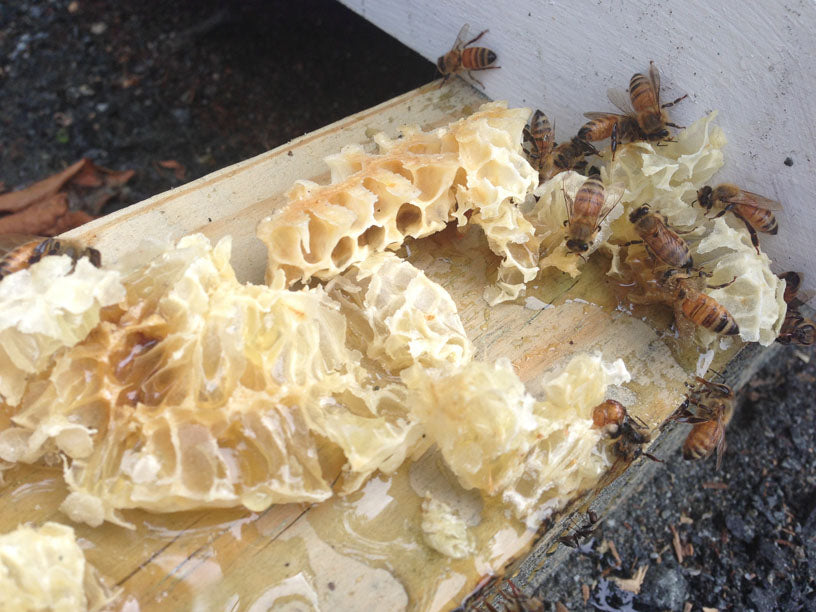
Bees lapping up honey running from a piece of burr comb just removed from the hive.
Housekeeping Tips for Beekeepers
When you scrape away unwanted burr comb, trust that your bees will tidy up the area in no time. They are relentless about hive order. Your job is to give them spacing that doesn’t create the problem in the first place, and good equipment with even frames goes a long way.
The Langstroth Hive and the Role of Bee Space
The Langstroth hive is the standard across much of the world, and bee space is the reason it works. The design is credited to Reverend Lorenzo Langstroth, who patented his movable-frame hive in 1852. He didn’t invent bee space (the bees did, and earlier beekeepers had noticed it), but he was the first to build a practical hive around it. Here is why that design has lasted:
Smart hive design
- Modularity: vertically stacked boxes that expand as the colony grows.
- Removable frames: comb you can inspect and harvest without destroying it.
- Standardization: uniform box and frame sizes, so parts are interchangeable.
Bee space, the key idea
- The right gap: spacing in the one quarter to three eighths inch range keeps bees from filling it with comb or propolis.
- Easier management: frames stay free of heavy propolis sealing, so inspections go smoothly.
Why it matters in practice
- Reusable comb: drawn comb can go back on the hive after extraction, saving the bees the work of rebuilding.
- Easier monitoring: frames that lift out cleanly make it simpler to check on the colony and spot trouble early.
By organizing the entire hive around a single measurement, the Langstroth design turned beekeeping into something sustainable and repeatable. It changed how we work with hives, to the benefit of both the bees and the people keeping them.

Langstroth hives on the farm.
Bee Space Is Quietly Brilliant
Working with bee space is one of the more satisfying parts of beekeeping. It rewards accuracy and attention to detail. Keep your spacing right and your bees will reward you with frames that lift cleanly and comb you can actually use. When it comes to bees, a few millimeters one way or the other is the difference between a tidy hive and a wax-welded puzzle.
FAQs About Bee Space
What is bee space in beekeeping?
Bee space is the gap, roughly one quarter inch to three eighths inch (about 6 to 9 mm), that honey bees naturally keep open inside a hive as a passageway. Bees leave gaps in this range clear, build comb in gaps that are larger, and seal gaps that are smaller with propolis.
How big is bee space?
Bee space measures about one quarter inch to three eighths inch, with roughly five sixteenths inch (8 mm) considered the ideal that most beekeepers design their equipment around.
Why do bees build burr comb?
Bees build burr comb to close any gap larger than bee space. It usually appears when frames are spaced too far apart, seated unevenly, missing, or when mismatched equipment creates gaps the bees feel compelled to fill.
Should I remove burr comb from my hive?
Yes. Removing burr comb keeps frames from sticking together, makes inspections easier, helps with airflow, and lets you spot pests. After removing it, fix the spacing that caused it so it doesn’t return, and save the scraped wax to reuse.
Who discovered bee space?
Reverend Lorenzo Langstroth is credited with applying bee space to a practical hive design, patented in 1852. He did not invent the concept, since the bees create it naturally and earlier beekeepers had observed it, but he was the first to build a workable movable-frame hive around it.
Storey’s Guide to Keeping Honey Bees by Richard E. Bonney and Malcolm T. Sanford.