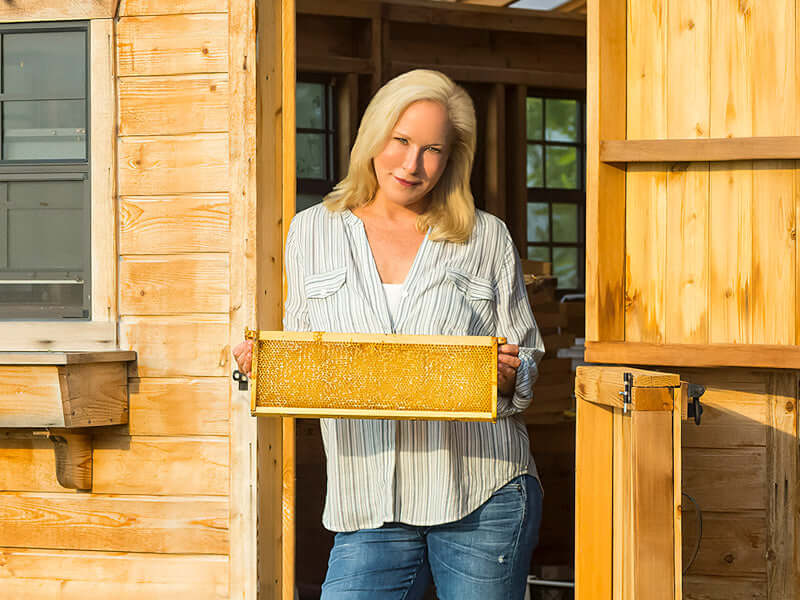


There is a neighborhood next door to the farm. I think about that more than you might expect.
I cannot control where my neighbors buy their plants. I cannot control what they put on their lawns, or what they hire someone else to put on their lawns. A honey bee will fly two or three miles from her hive to forage, which means my bees spend their working lives in places I have no say over whatsoever. That is the deal. You take it or you do not keep bees.
So when people ask me about glyphosate, the active ingredient in most of the weed killers sold at any hardware store in America, they are usually asking a simpler question than the one I end up answering. They want to know if it kills bees. The honest answer is that it is more complicated than yes or no, and the complicated version is more useful than either.
Why Everyone Assumed It Was Safe for Bees
Glyphosate works by shutting down a specific enzyme, called EPSPS, in a metabolic pathway that plants need to build certain amino acids. Block it and the plant starves. It is elegant chemistry, and it is why the stuff took over the world after its introduction in the 1970s.
Here is the part that mattered for decades: animals do not have that pathway. No EPSPS enzyme, no target, no effect. That reasoning is the entire foundation of the assumption that glyphosate is harmless to bees, and to us, and to everything else with a spine. It was not a marketing claim. It was a genuine and reasonable inference from how the molecule works.
Then researchers at the University of Texas looked closer, and found the gap in the logic.
What the Research Found
Bees are not just bees. A honey bee depends on a specialized community of gut bacteria, and that community does the work of helping her digest, grow, and fight off infection. It is a small ecosystem living inside a small animal.
And bacteria, unlike animals, do have the pathway glyphosate targets.
In a 2018 study published in the Proceedings of the National Academy of Sciences, Erick Motta, Kasie Raymann, and Nancy Moran exposed honey bees to glyphosate at concentrations bees actually encounter in crop fields, yards, and roadsides. They marked the bees with paint dots so they could track individuals and recapture them later. What they found was that glyphosate altered the bees' gut communities and left them more vulnerable to infection by opportunistic pathogens. The herbicide was not poisoning the bee directly. It was disrupting the bacteria she depends on, and the harm followed from there.
Motta's own summary of it stuck with me: current guidelines assume bees are not harmed by the herbicide, and the study shows that assumption is wrong. He was also careful about what it did not show. It is not the only thing causing bee deaths, but it is something worth worrying about, because glyphosate is used everywhere.
Other work has pointed in similar directions, including effects on foraging behavior and on the ability to navigate back to the hive. None of it says a bee lands on a sprayed weed and dies. All of it says the picture is less clean than "no target, no effect."
The Part Almost Nobody Talks About: It Is Not Just Glyphosate
This is the thing I most want people to understand, and it is the least discussed.
Nothing in that bottle is pure glyphosate. Commercial herbicides are mixtures: an active ingredient plus surfactants, adjuvants, and co-formulants that make the spray stick to a waxy leaf instead of beading off it. Those additions are what make the product work in the real world. They are also, legally speaking, often treated as inert.
They are not inert.
Motta and Moran followed their first study with a second one, testing bees on the actual formulation rather than glyphosate alone. Bees exposed to the formulation died at higher rates, and the researchers concluded the surfactants or other adjuvants were responsible for the increased mortality, not the glyphosate. A separate line of research on amphibians found the same shape of answer: the toxicity of glyphosate-based herbicides to tadpoles came mainly from the surfactant, not the active ingredient.
This is why studies on "glyphosate" sometimes disagree with each other. Some test the molecule. Some test what is in the bottle. Those are different experiments, and it is not obvious from the headline which one you are reading.
It also explains why my honest advice to a homeowner is so unsatisfying. Read the full ingredient panel, not the front of the bottle. And know that you may not find what you are looking for, because little information beyond the concentration of the active ingredient is routinely available on end-use pesticide labels. The formulation is frequently proprietary. You are being asked to evaluate a product whose contents you are not entitled to know.
Baltimore: Three Colonies, One Lesson
Some years ago I kept three hives in Baltimore. It was an experiment, and a genuinely fun one: I wanted to know how city honey would taste next to farm honey. Same beekeeper, same practices, different world. Terroir, but for bees.
I need to be precise here, because it matters. What my Baltimore neighbors sprayed was not glyphosate. They sprayed for mosquitoes, which means insecticide, a different chemical doing a different job. So this is not a story about the herbicide. It is a story about the thing underneath the herbicide, which is that a hive lives in a neighborhood that never gets a vote.
I have never seen bees like that. Not before, not since.
They were abundant and they were furious. At the farm I can walk up to a hive without smoke and nothing happens. In Baltimore I always carried smoke and it did not matter. Those bees would spend everything they had pelting me, throwing themselves against my suit, if I came anywhere near. The hives became unapproachable. I called in favors from a few beekeeping friends and we moved all three out to the farm, in their second or third month, late in the month.
Once they got to the farm, they became different colonies. Calm. Recognizable as bees I understood.
They did not make it through the rest of the year. And I want to be careful with you: I do not know why. I never found out. There was no way for me to isolate a cause, and I am not going to stand here and tell you the mosquito spray killed my bees, because I cannot prove that and it would be easy and dishonest to say. Colonies fail for many reasons. What I can tell you is exactly what I observed. They were angry in a way I have never seen. They calmed down when we moved them. They died anyway. Those three facts sit next to each other and I have never been able to draw a line between them.
They never made honey. I never got my answer about how Baltimore would taste.
What Mosquito Spraying Actually Does
I do not think my neighbor knew. That is the part I have made peace with. I do not believe he understood what he was releasing or what else it touched, and I think that is the first problem: not malice, just nobody ever told him.
So here is what I have learned since, from people who study this.
There is no insecticide that targets adult mosquitoes and leaves pollinators alone. That is not a matter of picking the right product. Bifenthrin, deltamethrin, and permethrin are all common in mosquito sprays, and all of them can kill bees on contact. The chemistry does not distinguish between an insect you dislike and an insect you depend on. Both are insects.
The part that gets me is that it frequently does not even work. One study found spraying had almost no effect on Culex mosquitoes, one of the most common kinds, because they spend most of their time up in the tree canopy where the spray never reaches. Mosquitoes fly half a mile to two miles, so any that are knocked down get replaced by more from down the block within days. Meanwhile the residual pesticide can persist for several weeks, continuing to harm the insects that visit and feed on the treated plants.
Read that sequence again. The mosquitoes come back in a week. The residue stays for a month. You poisoned the block and you are still getting bitten.
What Actually Works Instead
I am not a mosquito expert and I am not going to pretend. But I went and read what the extension services and entomologists recommend, and their answers are consistent enough that I trust the shape of them.
The single most effective thing is source reduction, which is a technical way of saying dump out the water. Mosquitoes breed in standing water, and they need remarkably little of it: clogged gutters, birdbaths, plant saucers, old tires, a forgotten bucket, a kid's toy. Walking your property once a week and emptying anything holding water attacks mosquitoes at the larval stage, before they ever fly. It touches no pollinator at all, because the bees were never in your gutter.
Second is Bti, short for Bacillus thuringiensis israelensis. It is a bacterium that occurs naturally in soil, and it kills mosquito larvae in standing water while leaving pollinators, fish, birds, and mammals alone when it is used correctly. If you have a rain barrel or a pond or a low spot that never drains, this is the tool.
Third is habitat. Encouraging the animals that already eat mosquitoes helps: dragonflies and damselflies are especially good at it, since their young live in water and prey on mosquito larvae there. So do frogs, toads, and bats. A yard planted densely with natives gives those predators somewhere to live, and a rain garden does double duty by reducing standing water while feeding pollinators. If you want to do one thing that helps my bees and your mosquito problem at the same time, that is it.
And if you truly cannot avoid spraying: never spray anything in bloom, since a flowering plant is a bee cafeteria. Apply at dawn or dusk when pollinators are not flying. Target the shady, damp places mosquitoes actually rest rather than blanketing the lawn, where they are not. Do not spray on a windy day or right before rain, unless your goal is to send it somewhere you did not intend. And be skeptical of "natural" and "bee-safe" marketing: ask to see the label, because essential-oil products sometimes contain a conventional pesticide alongside the oils, and most oils evaporate within an hour anyway.
Why Europe and America Answer This Differently
People assume Europe banned glyphosate. It did not. The European Commission renewed its approval in November 2023 for another ten years, through December 2033.
But something more interesting is going on, and it is worth understanding correctly.
The two systems ask different questions. The European approach leans toward hazard: if a substance can cause harm, that alone can justify restricting it. The American approach leans toward risk: harm depends on the dose and on real-world exposure, so the question becomes whether people are actually exposed to enough to matter. Neither is unreasonable. The first catches problems earlier and also restricts things that turn out to be fine. The second permits things longer and demands more proof before acting.
Where Europe is plainly ahead on bees is a different chemical family. Three neonicotinoid insecticides, imidacloprid, clothianidin, and thiamethoxam, have been banned for outdoor use across the EU since 2018, specifically because of the threat to pollinators. That ban is still fully in force. Those same compounds remain legal here.
And on glyphosate, individual European countries set their own rules on top of the EU approval. Austria, France, the Netherlands, Belgium, Luxembourg, and Germany have all introduced partial bans. Several restrict spraying near homes, schools, and hospitals. France banned household use outright. The room for a hobby gardener to use it keeps shrinking, year over year.
So the honest version of "why can they and we cannot" is not that Europe outlawed the chemical. It is that Europe drew a line around where ordinary people can use it, near the places where children and neighbors and hives actually are, and we have not.
Ours is not settled either. In June 2022 the Ninth Circuit Court of Appeals vacated the human-health portion of the EPA's 2020 interim decision on glyphosate, finding the agency's conclusion was not supported by substantial evidence. The EPA withdrew the remainder later that year and went back to work on a full registration review. Glyphosate stayed on the market throughout, and it is still there. Anyone who tells you the science is closed, in either direction, is selling something.
The Hard Truth
Backyard beekeeping in a suburban neighborhood probably is not for everyone.
I say that as someone who tried it and lost the bees. It is not about whether you are a careful beekeeper. You can do everything right inside your own fence and it will not matter, because your bees are not living inside your fence. They are foraging across every yard for two miles in each direction, and every one of those yards belongs to somebody who bought their plants somewhere you did not choose, treats their lawn on a schedule you do not know, and sprays for pests on a day nobody tells you about. Too many people simply have not been given the information to make those choices differently. That is not a character flaw. It is an education gap, and it is enormous.
I do not say this to talk anyone out of keeping bees. I say it because the version of this story where the beekeeper wins through diligence is not true, and you deserve to know that before you buy a hive.
And Then the Fence
Here is the one thing I know actually works.
At the farm, I hear from neighbors that people who know me have mentioned to their neighbors that there is an apiary next door. Not a campaign. Not a petition. Just somebody saying it over a fence, in passing, the way you would mention that a family down the street has a new baby.
And it changes what people do. Not because anyone was shamed into it, but because most people genuinely do not want to hurt something, and they simply did not know it was there. A person who knows there are hives nearby will think twice before booking a spray service. That is the whole mechanism. It is unglamorous and it is the only thing I have ever seen move the needle.
If you keep bees, tell your neighbors. If you have a neighbor who keeps bees, tell the next one over.
My Baltimore neighbor never knew. I never told him. I have thought about that for years.

FAQs About Glyphosate and Bees: What a Beekeeper Watches For
Does glyphosate kill bees?
Not directly, in the way an insecticide does. Glyphosate targets an enzyme found in plants and microorganisms but not in animals, which is why it was long assumed to be harmless to bees. A 2018 study published in the Proceedings of the National Academy of Sciences found the gap in that reasoning: honey bees depend on gut bacteria, and those bacteria do have the targeted enzyme. Bees exposed to glyphosate at levels found in fields, yards, and roadsides showed altered gut communities and greater vulnerability to infection. The researchers were clear that it is not the only factor in bee declines, but that current guidelines wrongly assume bees are unaffected.
Is Roundup safe for bees?
Commercial weed killers are mixtures, not pure glyphosate. They include surfactants and adjuvants that help the spray stick to leaves. The same University of Texas researchers ran a follow-up study using the herbicide formulation rather than glyphosate alone, and bees died at higher rates; they concluded the surfactants or other adjuvants were responsible for the increased mortality, not the glyphosate. This is one reason studies on glyphosate can appear to disagree: some test the molecule, others test what is actually in the bottle.
Does mosquito spray kill bees?
Yes. There is no insecticide targeting adult mosquitoes that spares pollinators and other beneficial insects. Bifenthrin, deltamethrin, and permethrin are common in mosquito treatments and can kill bees on contact. The chemistry cannot distinguish between an insect you want gone and one you depend on.
How can I control mosquitoes without harming bees?
Start with source reduction: empty anything holding standing water once a week, including gutters, birdbaths, plant saucers, buckets, and toys. This kills mosquitoes at the larval stage and touches no pollinators. For water you cannot drain, such as rain barrels or ponds, Bti (Bacillus thuringiensis israelensis) is a naturally occurring soil bacterium that targets mosquito larvae while leaving pollinators, fish, birds, and mammals unharmed when used correctly. Native plantings and rain gardens support dragonflies, frogs, toads, and bats, all of which eat mosquitoes.
Does spraying for mosquitoes even work?
Often less than people expect. One study found spraying had almost no effect on Culex mosquitoes, a common genus, because they spend most of their time in the tree canopy where spray does not reach. Mosquitoes travel half a mile to two miles, so treated areas repopulate quickly from surrounding properties. Meanwhile the residual pesticide can persist for several weeks, continuing to affect insects that visit treated plants.
Is glyphosate banned in Europe?
No. The European Commission renewed glyphosate's approval in November 2023 for ten years, through December 2033. Individual member countries set additional rules, and Austria, France, the Netherlands, Belgium, Luxembourg, and Germany have introduced partial bans, several restricting use near homes, schools, and hospitals. Where Europe is clearly ahead on pollinators is a different chemical family: three neonicotinoid insecticides have been banned for outdoor use across the EU since 2018 because of the threat to bees, and remain legal in the United States.
How far do honey bees travel from the hive?
Foragers commonly range two to three miles from the hive, and will go farther when forage is scarce. This is why a beekeeper has so little control over what their bees encounter. The bees are working across every property within that radius, regardless of who owns it or what is applied there.
Can you keep bees in a suburban neighborhood?
You can, and many people do successfully. But careful beekeeping inside your own yard cannot compensate for what happens across the two-mile radius your bees forage in. Neighbors choose plants, lawn treatments, and pest services without any obligation to tell you. The most effective protection anyone has found is simply making neighbors aware that an apiary is nearby, since most people who spray have no idea hives are close.
What should I look for on a weed killer label?
Read the full ingredient panel rather than the front of the bottle, but know the limits of what you will find. Little information beyond the concentration of the active ingredient is routinely disclosed on end-use pesticide labels, and formulations are frequently proprietary. Be especially skeptical of products marketed as natural or bee-safe: ask to see the label, since some essential-oil products also contain a conventional pesticide.