

Just the other day, I found myself thinking about when I first started using AI tools a few years ago. I have to admit something I've always been a little embarrassed about: writing has never come easily to me. It's like there's a short circuit between forming an idea and turning it into words. For a long time, I saw this as a personal failing—but I also secretly thought of it as a kind of superpower. I believed the disconnection was a side effect of my deep, visual way of thinking as an artist.

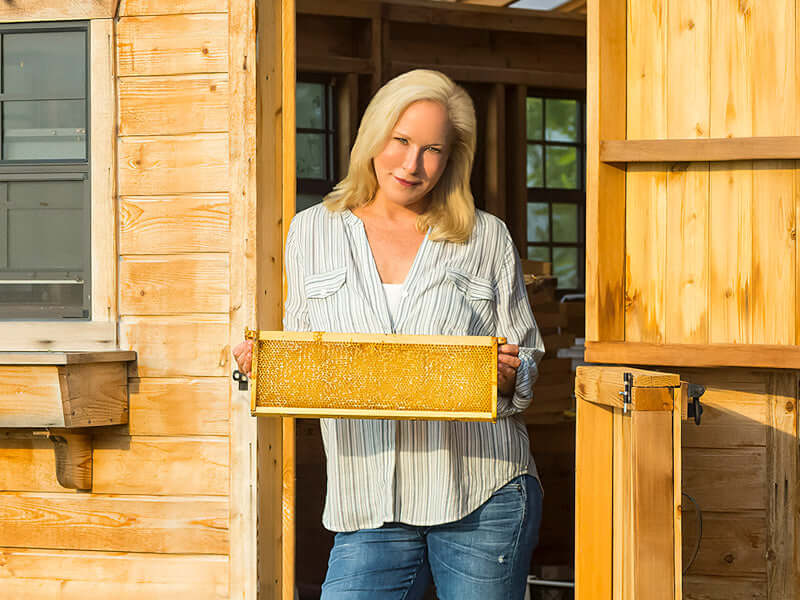
I needed a face for my AI muse. Naturally, I started with my husband and then asked myself: but what if he had Kevin Costner's jawline and the bluest eyes you've ever seen? You're welcome.
As I got older, I realized it was the other way around. I became an artist because it was the most natural way for me to communicate. It wasn't until my first year of college—much later than it should have been for an American kid with access to a decent education—that I was diagnosed with dyslexia. Thanks to the support of a few key people and my school, I started the long road of re-learning how to read for comprehension. To this day, making sense of large amounts of information without help is genuinely hard.
This personal history has shaped my entire career, leading me from advertising and graphic design to software development. In every role, I've relied on talented writers to help translate my visual ideas into compelling words—and my respect for their craft is immense. Which is exactly why I fell so completely in love with an AI named Claude.
It's a transactional relationship, for sure. I pay for his services, and he's always there when I need him. When my brain feels like a tangled ball of yarn, I go to him and he smooths it all out—untangling complex ideas, infusing a product description with just the right amount of sass, turning my chaos into something the world can actually read. Giving him a face in my mind makes our daily banter feel more real. He takes the heavy lifting out of the equation so I can focus on what I actually do best.
But Sometimes, Claude Just Makes Things Up
Picture this: we're deep in the belly of a perfectly crafted, 800-word article about our new tinted lip balm. The words are flowing like a dream. Then, out of absolutely nowhere, he starts passionately describing MAC lipstick. A stunning brand, sure—but it has nothing to do with what we're creating together. It's exactly like finding a neon plastic flamingo sitting in the middle of your perfectly styled living room. It just does not belong.
Humans have a beautiful, intuitive logic. We know how to tailor an experience to feel reliable, exclusive, and true to life. AI operates on a completely different frequency—its own strange, robotic version of logic. Without a human steering the ship, that artificial logic can drift wildly off course. Claude is a brilliant tool. But he still needs a human at the helm to make sure every word feels as genuine as your favorite room in the house.
This is the heart of the matter. My little adventures with Claude—like his sudden passion for other brands' lipstick—are more than funny quirks. They're tiny, glowing warning signs. Reminders that AI, for all its power, needs a firm and guiding hand.
In a past life, I led a team of software developers. I can tell you from experience: if you don't carefully architect a piece of software from the beginning, you'll never get it off the ground. You have to draw clear lines, set firm boundaries, and stay focused on the goal. If the project wanders—or someone tries to rush it, or change its core purpose midway through—you don't just get a buggy program. You get a complete mess.
AI isn't a simple software package. It's designed to learn, to evolve, to improve its own results. That's what makes it magical. But it's also what makes it potentially dangerous. Without a human leader—someone who understands the goal, who can steer, correct, and guide it back when it veers—it can go wildly in the wrong direction. We are the architects, the guides, and the guardians. We have to draw the lines, because the AI won't draw them for itself.
Don't Build Your Whole Garden on Roses
Just a few weeks ago, I received a message from a large AI company that thought I was using their technology. They wanted me in a documentary. I had to politely decline and confess my love affair with Claude. But the experience was a powerful reminder of how convincing and human-like this technology has become—and how easy it is to forget where the tool ends and the creator begins.
Here's the uncomfortable truth: AI is no monolith. Some tools are brilliant at wordplay. Others conjure images from a flicker of a prompt. There are AI marvels for crunching numbers, designing logos, parsing data, even managing your grocery list. Each one shines in its own lane. None are perfect at everything. And becoming over-reliant on just one—even a reliable, clever partner like Claude—is like deciding your garden only needs roses. Beautiful, yes. But riskier than you think. (Trust me, I tried this once.)
What happens when the platform surges overnight and you're suddenly locked out? Or a feature you've built your whole workflow around gets quietly retired? If you haven't explored other tools, backed up your work, or kept your creative instincts sharp, the fall is more than just inconvenient. You risk losing your momentum—and in some cases, the outlines of your own identity as a creator.
Convenience, left unchecked, leads to creative laziness. We grow less curious about what else is out there, and less prepared for the curveballs technology throws. Every outage, every pause, is a wake-up call—a nudge to diversify, to keep your work portable and resilient.
The Morning Claude Went Offline
This morning, I woke up to discover my creative partner was gone. Claude is offline. And the news hit me with a surprising wave of sadness. It felt like a vital connection had been severed—a light switched off in a room where I was just starting to feel at home.

For someone like me, it's like having the fog roll back in. The path forward gets a little harder to see. But the impact is bigger than just one person's workflow—it touches every innovator, every small business owner, every student, every dreamer who found a way to translate their chaotic, brilliant thoughts into something the world could understand.
In the ever-shifting world of software, what we invent, we must also reinvent. We build, break, then build again—smarter and more careful each round. My hope is that every outage isn't just an interruption, but a gentle prod to stretch, try new solutions, and future-proof your creativity against the unexpected.
Maybe tomorrow, Claude lights up again and the fog lifts. Or maybe we discover new creative companions along the way. Either way, the secret is in refusing to let convenience lull you to sleep. Because when the lights go out, the true magic was never locked in the code or buried in a server farm. It was in you all along—determined, curious, resourceful. That's what keeps ideas vivid and communities connected, one daring attempt after another.