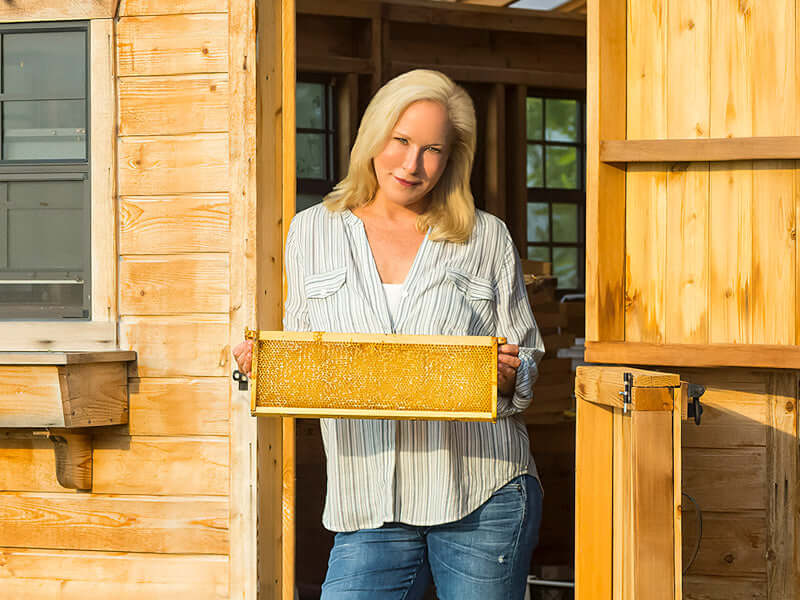


Every year, for roughly two weeks in late June and early July, cranberry plants bloom across the bogs and wetlands of New England. The flowers are small and pink, barely noticed by anyone who isn't a beekeeper or a cranberry farmer. But for the honey bees working those bogs, it's one of the most productive foraging windows of the year — and the honey they produce during that window is unlike anything else on the shelf. This is cranberry honey: a true monofloral, rare by nature, with a flavor profile that carries the quiet tartness of its source.
The Cranberry Bog: An Unlikely Habitat
Cranberry plants don't grow in ordinary garden soil. They're native to North America and have specific requirements — acidic, sandy, water-logged ground — that limits where they thrive. The bogs of Massachusetts and the Pine Barrens of New Jersey are two of the most concentrated growing regions in the country, and both have been cultivated for cranberry production for generations. The plants themselves are low-growing perennial vines that spread across the bog floor, rooting as they go. They don't die back in winter; they persist year after year in the same ground.
What's unusual about cranberry cultivation is how much it depends on water management. Cranberry bogs are engineered environments — growers flood them in winter to protect the vines from freezing, drain them in spring to allow growth, flood them again at harvest to float the berries to the surface. The iconic image of bright red cranberries floating in water is a harvest technique, not the natural state of the plant. In summer, between the drainage and the harvest flood, the vines spread across what looks like dry ground, and that's when they bloom.

The Two-Week Bloom and Why it Matters
Cranberry flowers open in late June and typically finish by mid-July. That's the window — roughly two weeks, sometimes less depending on the weather. The blossoms are distinctive up close: small, recurved pink petals that sweep back to expose the stamens, giving them a shape that looks almost like a tiny shooting star. Cranberry farmers have historically called them crane berries — a name that may be the origin of the word "cranberry" itself — because the flower's shape resembles the neck and head of a crane.
For beekeepers, this bloom window is both an opportunity and a logistical challenge. Hives have to be positioned near the bogs before the bloom starts — close enough that foraging bees can work the flowers throughout the two weeks. Then the harvest window closes fast. Once cranberry blossoms fade and bees begin moving on to other late-summer flowers, the nectar source is gone for the year. Any honey stored in the comb after that point will begin mixing with other floral sources, diluting the monofloral character. Beekeepers who want true cranberry blossom honey need to extract promptly.
Weather during those two weeks is the wild card. Cool temperatures slow bee flight. Heavy rain keeps bees in the hive and washes nectar from open flowers. A difficult July can cut a cranberry honey harvest significantly — which is part of why it's genuinely hard to find and why production varies from year to year.

Bees and Cranberry Farmers: A Working Relationship
The connection between honey bees and cranberry bogs goes well beyond honey. Cranberry plants require cross-pollination to set fruit — pollen from one blossom needs to reach another for the berry to develop. Wild bumblebees do some of this work naturally, but commercial cranberry production depends heavily on managed honey bee colonies placed directly in and around the bogs during bloom.
As a honey bee visits a cranberry flower to collect nectar, pollen attaches to her body. When she moves to the next flower, some of that pollen transfers. Done across thousands of flowers by tens of thousands of bees, this process directly determines how many berries a bog will produce. Cranberry yields improve sustainability with adequate honey bee pollination, and growers know it. Bringing in hives at bloom time is standard practice on commercial cranberry farms, not an optional add-on.
For the beekeeper, the arrangement works in both directions. The grower gets pollination services. The beekeeper gets access to a concentrated nectar source during a bloom that most hives would never encounter otherwise. It's one of the cleaner examples of the practical relationship between agriculture and beekeeping — both parties need something the other provides, and the honey is a byproduct of that exchange.

From Nectar to Honey: What Happens in the Hive
When a forager bee returns to the hive with a load of cranberry nectar, she passes it to a house bee through a process called trophallaxis — essentially mouth-to-mouth transfer. The house bee begins working the nectar immediately, chewing it and exposing it to enzymes produced in her honey stomach. Those enzymes begin breaking down the complex sugars in the nectar into simpler ones, primarily fructose and glucose.
The nectar is then deposited into an open cell of honeycomb and left to evaporate. Bees fan the comb with their wings to accelerate moisture loss — cranberry nectar, like most flower nectar, arrives at around 70-80% water. Finished honey sits at around 17-18% moisture. Once a cell reaches that point, bees cap it with wax to seal it. That capped honey is what beekeepers harvest.
With a minimally filtered honey like ours, what goes into the jar is as close to that capped honey as handling allows. The extraction process removes large debris — comb fragments, wax — but leaves intact the enzymes, pollen, and trace compounds that heavy filtration or high-heat pasteurization would strip out. The pollen in particular is worth noting: under a microscope, minimally filtered honey contains identifiable pollen grains from the flowers bees visited. In a well-sourced cranberry blossom honey, cranberry pollen should be dominant. It's one of the ways authenticity can be verified and one of the reasons minimal filtration matters.

What Cranberry Blossom Honey Looks and Tastes Like
The color is medium amber, sometimes with a warm, reddish tone that hints at its origin — lighter than buckwheat, darker than a pale clover. Held up to light, there's a richness to it.
The flavor is the reason people seek it out. Cranberry blossom honey has balanced sweetness with a gentle tartness and a quiet cranberry tang underneath — not the sharp bite of the fresh fruit, but an echo of it. It's sweet enough to use anywhere you'd reach for honey, distinctive enough that you'll notice the difference on a plain piece of bread or dissolved in tea with nothing competing with it. The character comes from the nectar itself — the cranberry plant's mild acidity carries through into the finished honey in a way that neutral clovers simply don't have.
Like most minimally filtered honeys, it will crystallize over time. That's not spoilage — it's what unprocessed honey does as glucose molecules naturally solidify. To return it to liquid, set the jar in a bowl of warm (not boiling) water and let it sit.

How to Use Cranberry Honey in the Kitchen
the tartness is the thing to cook with. It gives cranberry honey a range that neutral honeys don't have — it can go sweet or savory without tipping into cloying territory.
On a cheese board, it pairs cleanly with brie, sharp cheddar, or goat cheese, where the tartness does the work that you'd otherwise as a fruit preserve to do. In tea, it dissolves readily and adds a complexity that plain sweetener doesn't. In cranberry-forward recipes, it amplifies rather than competes — our cranberry orange apple relish was written with this honey in mind, as was the cranberry curd tart, where the honey's own acidity reinforces the curd rather than fighting it.
In drinks, the flavor holds up well. It works in a holiday margarita built around cranberry, and it adds depth to mulled wine without overwhelming the spices. For a Thanksgiving table, a jar alongside the bread basket or stirred into the cranberry sauce earns its place without any extra explanation needed.


FAQs About What Is Cranberry Blossom Honey?
What is cranberry blossom honey?
Cranberry blossom honey is monofloral honey made by bees foraging primarily on cranberry plant flowers during the two-week summer bloom in New England bogs. The short bloom window and specific growing geography make it one of the rarer honey varietals available in the U.S.
What does cranberry honey taste like?
Balanced sweetness with a gentle tartness and a quiet cranberry tang — subtler than the fruit itself, but distinct from a neutral wildflower or clover honey. The character comes through most clearly on its own: in tea, on bread, or drizzled over cheese without much competing with it.
How is your cranberry honey made?
Our cranberry honey is minimally filtered and contains no additives, no added sugars, and no artificial flavors. It is honey handled as little as possible between hive and jar. Questions about what any food does for your health go further than a honey label can honestly answer.
How long does it take to ferment cranberries into honey?
Fermenting cranberries in honey is a separate process from honey production, it involves submerging fresh cranberries in minimally filtered honey and allowing wild yeasts on the fruit’s surface to begin fermentation over several weeks. The timeline varies depending on temperature, the water content of the honey used, and how active the natural yeasts are. Most recipes suggest a minimum of two to four weeks before the ferment develops much character, with many people leaving it longer. minimally filtered honey is the right starting point for this project, since pasteurized honey has reduced yeast activity. Cranberry honey is a natural match for it given the shared flavor profile.
Where does cranberry blossom honey come from?
Primarily from Massachusetts and New Jersey, where cranberry cultivation is most concentrated. Our cranberry honey is sourced from Massachusetts bogs.