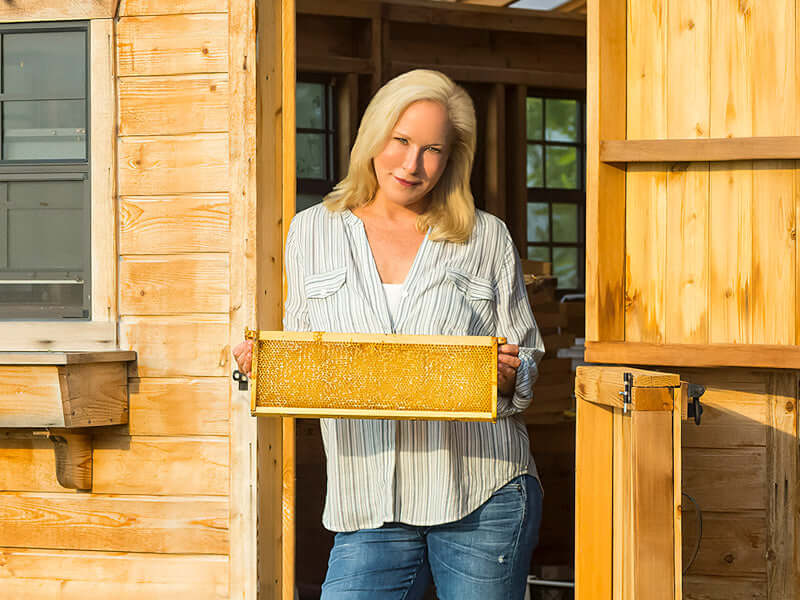


Most honey gets its name from the flowers that feed the bees — clover honey from clover fields, orange blossom honey from citrus groves, tupelo honey from tupelo trees along southern river swamps. Raspberry honey, a monofloral honey, follows the same logic: it's made by bees working raspberry blossoms, and it tastes like it. Not like raspberry jam or raspberry extract, but like the flower itself — bright, sweet, and faintly floral in a way that's distinct from any other berry varietal you'll find.

It's also one of the rarer honeys on the market. Raspberry blossoms open for a narrow window each spring, the nectar yield per flower is modest, and the beekeeping operations positioned near commercial raspberry fields are few. What reaches the jar is the concentrated result of a short, specific season — and that scarcity is part of what makes it worth understanding.
How Raspberry Honey Is Made
Raspberry plants and honeybees have a relationship that benefits both in measurable ways. Raspberry flowers produce nectar to attract pollinators, and bees collect that nectar to bring back to the hive. In the process, they transfer pollen between blossoms, which is what allows the plant to set fruit. Studies on raspberry pollination have consistently shown that bee-visited plants produce larger, more uniform berries than those left to self-pollinate or visited only by wind. The bees aren't incidental to the raspberry harvest — they're essential to it.
The bloom period for raspberry varies by region and variety, but in Washington state — where much of the commercial raspberry crop in the United States is grown — it typically falls in late spring. The window is short, often just a few weeks, and beekeepers who want to produce a true monofloral raspberry honey need their hives positioned near the fields and ready to work during that specific period. Once the bloom passes, the nectar source is gone for the year.
Back at the hive, bees process the nectar — evaporating moisture, adding enzymes — until it reaches the low water content that makes honey shelf-stable. A minimally filtered raspberry honey goes from hive to jar with as little processing as possible, which preserves the floral character that makes the varietal identifiable.

What Does Raspberry Honey Taste Like?
The flavor profile of raspberry blossom honey surprises people who expect it to taste like the fruit. It doesn't — at least not directly. What you get instead is brightly sweet with a syrupy body, and underneath that sweetness, distinct notes of pollen and ripe berries with a mild earthiness in the finish. The berry quality reads as genuine rather than candy-like, and there's a complexity to it that flat fruit-flavored sweeteners don't have.
Compared to a wildflower honey, raspberry honey is cleaner and more focused — less variation, more of a single clear note. Compared to a delicate varietal like acacia or linden, it's more assertive. It holds its own in recipes without being overpowering, which makes it genuinely versatile in the kitchen.
The texture tends toward the syrupy end of the spectrum — it pours smoothly and coats well, which matters when you're drizzling it over food rather than stirring it into something.
What Does Raspberry Honey Smell Like?
The aroma is one of the more distinctive things about this varietal. Raspberry blossom honey has a delicate, almost powdery floral quality — noticeably different from the richer, more caramelized scent of a darker honey like buckwheat, and different again from the citrusy brightness of orange blossom. There's a berry presence in the nose, but it's light, not jammy. Open the jar and you get something that smells like a raspberry field in early morning — floral forward, with the fruit underneath.

The Color
Raspberry honey is typically light amber, often with a warm golden tone. It's lighter than most wildflower honeys and darker than the near-water clarity of acacia. The color can shift slightly depending on the specific season and the ratio of raspberry nectar to any other nearby flowers the bees visited, but a light amber is the reliable baseline.
How to Use Raspberry Honey
The flavor profile — bright, berry-forward, syrupy — makes raspberry honey a natural fit for applications where you want sweetness with character rather than neutral sweetness.
With cheese: It pairs well with soft, fresh cheeses — ricotta, fresh chèvre, burrata — where its brightness cuts through the creaminess without competing with it. On a cheese board, it also works alongside a young brie or a mild blue. The berry notes make the pairing feel intentional rather than generic.
With yogurt and fresh fruit: Stir it into plain yogurt with summer berries and you'll understand immediately why monofloral honey matters. The raspberry honey amplifies the fruit rather than masking it. This is one of the simplest and most effective uses for it.
In vinaigrettes: The bright, slightly acidic quality of raspberry honey plays well with vinegar in a salad dressing, particularly over bitter greens like arugula or radicchio where the sweetness provides balance. Use it anywhere a recipe calls for honey but you want the dressing to have a more distinct flavor.
In tea: Stirred into black tea or a fruity herbal, the floral notes of raspberry honey come through clearly in a way they might not in a baked good. It's a good everyday use that lets you work through a jar without losing the flavor to a more dominant ingredient.
In baking and desserts: The berry notes hold reasonably well in baking, though some of the more delicate floral character will cook off. It works well in shortcakes, fruit crumbles, honey cakes, and anywhere you want a berry undercurrent without adding actual fruit. It's also excellent drizzled over vanilla ice cream or panna cotta. For a straightforward way to put it to work, try it in our Chocolate Raspberry Chia Pudding — the honey is an ingredient in the recipe itself — or use it in place of wildflower honey in our two-ingredient fruit honey sorbet for a more pronounced berry flavor throughout.
In cocktails and mocktails: The syrupy texture and bright flavor make raspberry honey a natural cocktail sweetener. Use it in place of simple syrup in drinks built around gin, vodka, or Champagne, or stir it into sparkling water with a squeeze of lemon for a quick, elegant non-alcoholic option — our Sparkling Strawberry Lemonade uses a similar approach and adapts well with raspberry honey in place of wildflower.

Does Raspberry Honey Crystallize?
Yes — like most minimally filtered honeys, raspberry honey will crystallize over time. This is not a flaw. Crystallization is what happens when glucose in the honey precipitates out of solution, and it's a reliable indicator that the honey hasn't been heavily processed or adulterated. Heavily heated or ultra-filtered honeys resist crystallization precisely because processing has removed the particles that nucleate it — along with much of the character.
To return crystallized honey to a liquid state, place the jar in warm water (not boiling — excessive heat degrades flavor and destroys enzymes) and let it sit until it loosens. A consistently warm spot on the counter works for gradual softening over a day or two.
Where to Buy Raspberry Honey
Raspberry honey is genuinely hard to find outside of specialty producers. Most grocery store honey — even honey labeled as a specific varietal — is blended, heated, and filtered to the point where the original floral character is gone. If you're looking for a true raspberry blossom honey, you're looking for minimally filtered, and sourced from a region where commercial raspberry cultivation actually happens.
Our Raspberry Honey is sourced from beekeepers in Washington state, minimally filtered, and Star K Kosher certified. It's a limited-edition varietal — we source it in small quantities, and when the current supply is gone, we can't guarantee it comes back. If you've been curious about it, this is worth trying while it's available.


FAQs About What Is Raspberry Honey?
What is raspberry honey best used for?
Raspberry honey is particularly well suited for culinary applications where you want a sweetener with distinct berry character rather than neutral sweetness. It works well drizzled over cheese, stirred into yogurt, used in vinaigrettes and marinades, added to tea, and incorporated into baked goods and desserts. The syrupy texture makes it easy to drizzle, and the bright flavor holds up in both sweet and savory applications.
Is raspberry honey the same as honey flavored with raspberries?
No. Raspberry blossom honey gets its flavor from the nectar of raspberry flowers — nothing is added to it. Flavored honeys are produced by infusing a base honey with raspberry extract, juice, or fruit. True raspberry honey is a monofloral varietal, meaning the bees collected nectar primarily from raspberry blossoms and the flavor is entirely a product of that source. Always check the label: if the ingredients list anything beyond honey, it's flavored, not varietal.
What does raspberry honey taste like compared to regular honey?
Most "regular" honey sold in stores is a blend of multiple floral sources, lightly flavored and relatively neutral. Raspberry honey is more specific — brightly sweet with a syrupy body, and distinct notes of pollen, ripe berries, and earth. It has more personality than a generic clover or wildflower blend, and the berry quality is genuine rather than added. If you're used to supermarket honey, raspberry blossom honey will taste noticeably more complex.
Will raspberry honey crystallize?
Yes, and that’s a good sign. Minimally filtered honey crystallizes naturally over time, and it doesn’t mean the honey has gone bad or expired. To reliquefy it, place the jar in a bowl of warm water and let it gently warm through.
How should I store raspberry honey?
Store it at room temperature, away from direct sunlight and heat sources. Honey doesn't require refrigeration — in fact, refrigerating it accelerates crystallization. A pantry or cupboard is ideal. Kept properly sealed at room temperature, honey has an indefinite shelf life.
Is raspberry honey kosher?
Our Raspberry Honey is Star K Kosher certified. Kosher certification status varies by producer, so if you're purchasing from another source, check for certification documentation rather than assuming.
Why is raspberry honey considered a limited edition?
Raspberry blossom honey is produced during a narrow bloom window each spring, and only by beekeepers positioned near raspberry cultivation — a relatively small overlap of geography and timing. That makes the supply genuinely limited compared to more common varietals like clover or wildflower. We source ours in small quantities from Washington state, and we can't guarantee availability once a batch sells through. It's not a marketing device — it's a function of how rare this varietal actually is.