



Beeswax is produced entirely by honeybees, secreted from specialized glands on the underside of a worker bee's abdomen and shaped into the hexagonal cells that form the honeycomb inside a hive. It is one of the more remarkable materials in nature: created by insects, chemically complex, and useful across an extraordinary range of applications.
This page covers where beeswax comes from — the biology, the production process inside the hive, and the chemical composition that makes it so versatile. If you're looking for what to do with beeswax once you have it, we cover that in our guide to beeswax uses. For how to harvest and process it from your own hives, see our posts on processing beeswax and filtering beeswax.

Young worker bees make beeswax by secreting it from special wax glands on their abdomen
How Bees Produce Beeswax
Only young female worker bees produce beeswax, and only during a specific window of their lives. Bees develop eight wax-producing glands on the underside of their abdomens, which become active at around 12 days old and remain productive until approximately day 17. After that, the glands become inactive and the bee moves on to other roles in the colony.
The process begins when worker bees consume honey or nectar, which provides the energy required for wax production. The sugars from these sources are metabolized and converted into wax scales — thin, translucent flakes that emerge from the glands and harden when exposed to air. The wax initially appears clear and becomes opaque as the bees work it.
Hive workers collect these wax scales using their legs and shape them with their mandibles. To manipulate the wax effectively, bees must maintain an internal hive temperature of around 95 degrees Fahrenheit. The wax is softened by warmth and chewing, then pressed into the precise hexagonal cell shapes that form the honeycomb.
During comb construction, bees often form chains by linking their legs together while secreting and passing wax. This behavior is called festooning. The colony functions as a single organism during this process, with each bee contributing to a structure none of them could build alone.
Wax production is metabolically expensive. It takes approximately 6.66 to 8.80 kilograms of honey to yield one kilogram of beeswax, which is why bees build with precision and reuse comb wherever possible. Surplus honey and nectar are stored in comb on frames and only collected in quantities that ensure the colony can continue to thrive.

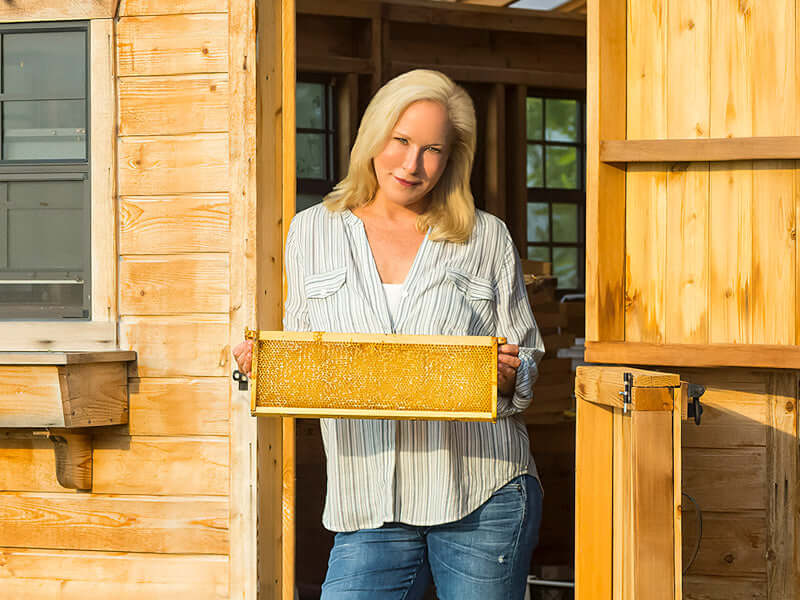
Our raw honeycomb contains beeswax in its natural, unprocessed form
The Role of Beeswax in the Hive
Beeswax is the structural foundation of the hive. The honeycomb it forms serves three distinct purposes simultaneously: a nursery for developing brood, a storage facility for pollen, and a repository for ripened honey. The hexagonal cell design is not arbitrary — it is one of the most efficient geometric structures for maximizing storage volume relative to the amount of material used to build it.
When bees have filled cells with ripened honey, they cap them with a fresh layer of beeswax to seal out moisture and debris. This is the same layer of cappings that beekeepers remove during honey harvesting, and the primary source of beeswax collected from hives. Because capping wax is newly produced and has never housed brood, it is the cleanest and lightest-colored wax the hive produces.
Beeswax also plays a maintenance role throughout the hive. If frames warp or gaps appear in the structure, worker bees fill them with wax to maintain the colony's environmental control. The hive's ability to regulate temperature, humidity, and airflow depends in part on this constant wax maintenance.
The color of beeswax varies depending on the pollen and propolis the bees have worked into it over time. Freshly produced cappings wax tends toward pale yellow or near-white. Older brood comb darkens significantly, eventually reaching brown or greenish-gray as it absorbs cocoon silk and debris. Color is a reliable indicator of wax age and relative cleanliness.

Chemical Composition of Beeswax
Beeswax produced by Apis mellifera (the Western honeybee) is a complex mixture of over 280 chemical compounds, primarily esters, fatty acids, and long-chain alcohols. The principal constituents are palmitate, palmitoleate, and oleate esters of long-chain aliphatic alcohols. Among the key components is triacontanyl palmitate, which alongside cerotic acid forms a ratio of approximately 6:1 — a proportion that gives beeswax its characteristic hardness and melting behavior.
Beeswax has a relatively low melting point, around 143 to 151 degrees Fahrenheit, which makes it workable at moderate heat while remaining solid at room temperature. It is not water soluble, is chemically stable, and resists oxidation — qualities that contribute to its longevity and usefulness across industries.
Beeswax can be broadly classified into European and Oriental types, each with distinct chemical profiles. European beeswax typically has a lower saponification value (3–5) compared to Oriental types (8–9), indicating differences in fatty acid composition. These differences affect how the wax performs in various applications.
Beeswax is frequently adulterated with plant waxes, paraffin, and other additives in the commercial supply chain. These additions can significantly alter its chemical composition and performance. This is worth knowing when sourcing beeswax for cosmetic or food applications, where purity matters. Pure beeswax has a natural, faintly honey-like scent and a consistent golden color — adulterated versions often lack both.
The chemical composition of any given batch of beeswax is also influenced by the diet of the bees, climate, and geographic location of the hive. These variables mean that beeswax from different regions or floral sources can have subtly different properties, even when produced by the same species.

From the Hive to Your Hands
Beeswax begins as a metabolic byproduct of a young worker bee, becomes the architecture of one of nature's most efficient structures, and ends up as an ingredient in products ranging from lip balm to furniture polish to fine art. That journey between the hive and finished product involves harvesting, processing, and filtering — each of which has its own considerations worth understanding.
For what to do with beeswax once you have it, see our full guide to beeswax uses around the home. For the practical steps of transforming raw cappings into usable wax, start with how to process beeswax, then read our notes on filtering beeswax — including what we learned the hard way with commercial equipment.
Caring for this land and these communities is at the core of who we are. It's why we created Roots & Wings — our giving initiative that connects every purchase to something that matters. See how we give back.
Updated 4/10/2026