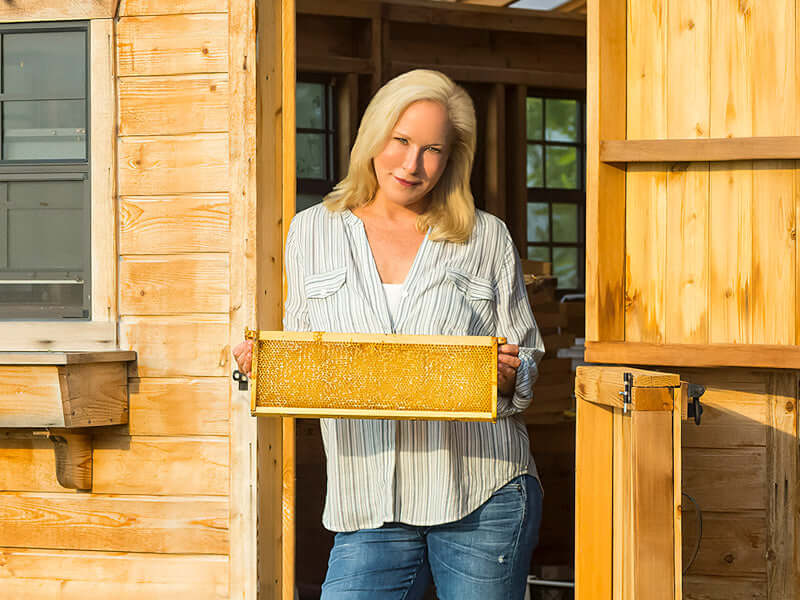


Have you ever watched bees pour in and out of a hive and wondered what we humans might learn from the way they organize themselves? As both a business owner and a beekeeper, I have spent years fascinated by the parallels between a honeybee colony and the way people behave in groups. So today I want to talk about hive mentality: what it actually means, where the phrase comes from, and how watching real hives can help us think more clearly about the metaphorical “hive minds” we build in our own communities.
Kara Brown keeps an apiary on the 102 acre Chesterhaven Beach Farm on the Chesapeake Bay, where she raises bees.
What Does Hive Mentality Mean?
Hive mentality, often used as a plain-English cousin of “groupthink,” describes what happens when individuals start putting group agreement ahead of their own thinking. The pull toward fitting in gets strong enough that people stop voicing doubts, and the group drifts toward whatever feels comfortable rather than whatever is correct.
It is not only a human thing. We borrow the term from social insects like honeybees, where thousands of individuals coordinate so tightly that the colony can look like a single organism making a single decision. In people, you see the same pattern in smaller doses: a meeting where nobody pushes back, a group chat where one opinion snowballs, a workplace where “the way we do things” quietly overrules better ideas.
The interesting part is that hive mentality is not purely good or bad. A group that pulls together shares a real sense of identity and purpose, and it can solve problems no single person could. The trouble starts when the desire to keep everyone happy starts crowding out honest disagreement. Recognizing that line is the whole game.

What Is a Hive Mind? Key Characteristics
Picture a system where lots of small minds, none of them especially clever on their own, add up to something that looks remarkably smart. That is the core idea behind a hive mind: a kind of collective intelligence that ends up greater than the sum of its parts. A few features show up again and again:
- Shared decision-making: choices emerge from many small inputs rather than one person’s call, which tends to produce well-rounded outcomes.
- Emergent group intelligence: the combined result often beats what any single member could manage alone.
- Strong influence on behavior: individuals take their cues from the group, which keeps everyone coordinated.
- A real risk to independent thinking: the same forces that create cohesion can quietly smother dissent and personal judgment.
- A foundation of trust and belonging: a hive mind only holds together when people actually want to cooperate.
That sense of belonging is powerful and motivating. The challenge is keeping it without losing the individual voices that keep a group honest. Groups that manage to value both collaboration and a little friction get the upside of collective intelligence while dodging most of the downside.

Do you know what festooning is?
Nature’s Original Hive Mind
When we reach for the phrase “hive mind” in human conversations, we are borrowing from the best example there is: the honeybee colony. A single hive can hold upwards of 50,000 worker bees, each one cycling through specialized jobs over a roughly six-week life. What is remarkable is not just the headcount, but how the whole group functions as one unit with nobody in charge.
Inside the dark of the hive, thousands of bees coordinate complicated work, from building mathematically precise honeycomb to holding the internal temperature remarkably steady, all without a manager handing out orders. Simple interactions between individuals add up to a kind of intelligence no single bee could possess.
Watching my own hives each morning, I am reminded that the internet, social platforms, and shared workspaces have created strangely similar dynamics for us. More and more, we act like connected nodes in a big network, where each small action feeds into a collective outcome nobody fully controls.

This infrared photo of my hives was taken during the winter.
Communication Is Everything
What really lets a colony behave like one mind is communication. When a forager finds a good patch of clover a couple of miles out, she comes home and performs the famous “waggle dance,” a looping figure-eight that tells her sisters both the distance and the direction of the find. Bees also trade information through pheromones, through vibration, and even through the act of sharing food mouth to mouth.
All of that signaling means important knowledge does not stay locked inside one bee; it becomes part of what the whole colony knows. Human groups work best when we build similar channels, whether that means transparent communication at work or online spaces that pass along something useful instead of noise. Cornell biologist Thomas Seeley, who has spent decades studying how colonies make decisions, describes this as a form of swarm intelligence: real problem-solving that emerges from a crowd of individuals pooling what they know.
The Dark Side of the Colony
Not everything in the hive is worth copying. Over my years of beekeeping, I have watched colony failures that rhyme uncomfortably with the ways human groups fall apart. It is a little like the Borg from Star Trek, where total conformity ends up hollowing out the whole.
Take Colony Collapse Disorder, which has hit bee populations hard. When a colony’s systems break down or stressors like varroa mites overwhelm its resilience, a hive that looked healthy can empty out almost overnight as the workers abandon it. Human organizations can unravel the same way when information stops flowing or outside pressure gets too heavy.

Colonies also suffer from what beekeepers call “queen failure”, where the hive is following a queen that is no longer laying well. The colony’s whole future rides on that one weak link. How many human organizations have quietly declined the same way, following leadership in a direction nobody felt safe questioning?
And then there is the colony’s lack of tolerance for anyone who does not fit. Drones get pushed out to die when resources run thin. Bees that fall ill may be removed for the good of the group. That ruthless math keeps the colony alive, but it is a chilling model for human societies, which have used the same logic to justify exclusion and worse.
Hive Mentality in the Digital Age
The internet has poured fuel on hive mentality. Social platforms and online communities are perfect breeding grounds for groupthink. On sites like Reddit and X, opinions spread and harden fast, and a loose crowd can start to feel and act like a single mind.
There is an upside: a connected crowd can pull in a huge range of information and crack problems quickly. But the same dynamic produces echo chambers, viral misinformation, and the kind of polarization where being in the group matters more than being right. The sense of belonging is real, and so is the cost to independent judgment.
The fixes are not complicated, even if they take effort: make room for dissent, reward people who ask the awkward question, keep communication open, and agree on what you are actually trying to do. Stay aware of the pull of the crowd and you can enjoy the benefits of collective thinking without handing over your ability to think for yourself.

Collective Action: The Miracle of Pollination
For all those cautions, the upside of a colony is undeniable. A single worker bee makes only about 1/12 of a teaspoon of honey in her whole life, hardly enough to notice. Yet together, a strong hive can produce well over 100 pounds in a good year while pollinating a huge share of the world’s flowering plants, including many of the food crops we depend on.
That multiplication of effort through coordination is exactly the promise of human collective action too. Whether it is a neighborhood project, a climate effort, or a team at work, our biggest wins come when we point our energy at a shared goal while still leaving room for the variety of approaches that keeps us resilient.
Finding Balance: Lessons from Sustainable Beekeeping
Modern beekeeping has a useful lesson about balancing the group against the individual. The strongest apiaries lean into genetic diversity, because a queen that mates with many drones produces a colony better able to cope with stress and changing conditions.
In the same way, where old-school beekeeping chased maximum honey at any cost, sustainable beekeeping pays attention to the overall health of the colony, knowing that a stressed hive produces less and breaks down faster. The takeaway for human groups is hard to miss: the most resilient “hive minds” are not the ones with the most rigid conformity or the most aggressive targets. They are the ones that cultivate different perspectives inside a shared sense of purpose.

Learn how to plant a pollinator garden.
Building Better Human Hives
Drawing on both beekeeping and running a business, here are five practical ways to build stronger collective thinking in a team or a community:
- Protect the flow of information: bees use several overlapping channels, so build more than one reliable way for important knowledge to move around.
- Value diversity, genetic and cognitive: the most resilient colonies have varied genetics; human groups should actively seek out different perspectives and backgrounds.
- Watch health, not just output: good beekeepers track many signs of colony wellbeing beyond honey yield, and good organizations track engagement and sustainability alongside results.
- Make space for constructive dissent: unlike a real hive, a human group benefits from a well-placed devil’s advocate who heads off groupthink.
- Balance the individual and the whole: the best colonies neither sacrifice every individual nor let one actor harm the group, and the same balance serves us.
What Bees Can Teach Us About Being Human
As I close up the hives for the evening and watch the last foragers come home heavy with pollen, I am reminded that bees have been refining their social organization for tens of millions of years. Across countless generations, they have worked out tough problems of coordination, resource sharing, and collective decision-making.
Our challenges and our gifts are our own, but there is real wisdom in seeing how nature’s most successful collective organisms operate. Study an actual hive and you start to understand both the promise and the pitfalls of our own growing interconnection.
So the next time you spot honeybees working the flowers in your garden, take a second to appreciate not just their role in the ecosystem, but the quiet social intelligence they represent, and think about what their very old wisdom might offer our very modern problems.
FAQs About Hive Mentality
What is hive mentality?
Hive mentality is the tendency for people in a group to prioritize agreement and belonging over their own independent judgment. It is closely related to groupthink, and the phrase borrows from honeybee colonies, where thousands of individuals coordinate so closely that the group can act like a single mind.
Is hive mentality the same as groupthink?
They overlap heavily and are often used interchangeably. Groupthink is the more formal psychology term for a group suppressing dissent to preserve harmony, while hive mentality is the everyday phrase that adds the honeybee metaphor. Both describe the same basic risk: cohesion crowding out honest disagreement.
Do bees actually have a hive mind?
In a sense, yes. No single bee is in charge, yet through simple interactions, signals like the waggle dance, and chemical cues, a colony coordinates complex tasks and makes group decisions. Researchers call this swarm intelligence, where collective behavior produces outcomes no individual bee could achieve alone.
Is hive mentality good or bad?
It is both, depending on the situation. The same forces that create shared purpose and let a group outperform any individual can also silence useful dissent and lead to poor decisions. The goal is to keep the cohesion while protecting space for independent thinking.
How can you avoid the downsides of hive mentality?
Encourage people to voice doubts, deliberately invite different perspectives, keep communication open and transparent, and set clear shared goals. Staying aware of the pull toward conformity is most of the battle, both online and in any team.