

A spa owner once told me, point blank, that her scrub line cost half of what ours does. I could hear the rest of the sentence before she said it: so why would I pay double? It’s a fair question, and one I think a lot of people ask quietly in the aisle, jar in hand, doing the math.
So instead of defending the price, I did something simpler. I put the two ingredient lists side by side. What that comparison shows is the whole argument, and it’s the reason I’m comfortable telling you exactly what you’re paying for.

Read the First Two Ingredients
You don’t need a chemistry degree to size up a body scrub. Ingredient lists are ordered by weight, so the first two or three items are most of what’s in the jar. Here are the two lists I compared, copied straight off the labels.
Our honey sugar scrub is made in-house by hand in small batches. Here's a close-up of the ingredients:
Cane Sugar, Honey Crystals (Dried Honey, Cane Juice and Molasses), Organic Sunflower Seed Oil, Organic Coconut Oil, Organic Stearic Acid, Organic Shea Butter, Organic Cocoa Butter, Polysorbate 20, Essential Oil Blend, Rosmarinus Officinalis (Rosemary) Leaf Extract, GMO-Free Mixed Tocopherols
The competitor’s salt scrub
Sodium Chloride, Water/Eau, Cocamidopropyl Betaine, Parfum (Synthetic Fragrance), Glycine Soja (Soybean) Oil, Sea Salt, Oryza Sativa (Rice Bran Oil), Tocopheryl Acetate, Polysorbate 20, Phenoxyethanol, Caprylyl Glycol, Citric Acid
Two products that do the same job on paper. Two completely different jars once you know what you’re looking at.
What That Gap Actually Buys You
Here’s where the price difference lives, line by line.
The second ingredient on their list is water. When water is that high up, a good portion of what’s in the jar is, well, water. Water also invites bacteria, which is why their list includes preservatives like Phenoxyethanol and Caprylyl Glycol to keep the formula shelf-stable. Our scrub is waterless. Sugar and oils don’t grow bacteria the way a watery formula does, so we skip the preservatives entirely. You’re paying for scrub, not filler.
Their fourth ingredient is Parfum, a synthetic fragrance. Ours is an essential oil blend. Synthetic fragrance is cheaper and louder; essential oils cost more and read as more layered and natural on the skin. If you’ve ever found a scented product overwhelming halfway through a shower, that flat, sharp note is usually synthetic parfum. Whether that matters is personal, but it’s a real difference in what you’re smelling and what you’re paying for.
Our formula is roughly 98% plant-derived. Organic sunflower oil, coconut oil, shea butter, and cocoa butter make up the bulk of it. Those are the ingredients that leave skin feeling soft after you rinse, rather than just freshly sanded. On the competitor’s list, the oils sit lower, below the water and the surfactant, which tells you how much of the jar they actually make up.

Our Original Honey Body Scrub is made with one ingredient: pure, crystallized honey.
So What Actually Makes a Scrub Worth It?
Strip away the marketing and a good scrub does three things. It exfoliates without shredding your skin, it leaves you feeling soft instead of stripped, and it smells like something you want to be near. The grain should break down as you work it in so you’re not scrubbing harder and harder against a coarse jar of salt. The oils should do enough that you don’t feel you have to slather on lotion the second you towel off. And the scent should come from somewhere real.
That’s the bar. Plenty of scrubs clear it, and plenty of expensive ones don’t. The ingredient list is how you tell the difference before you buy, and it’s a better guide than the price tag or the label on the front.
For more on technique, our guide on how to use a body scrub walks through prep and application, and if you want to know what the category covers in general, start with what a body scrub is.
The Honey Bee Behind the Ingredients
One thing that’s easy to miss: most of the plant ingredients we lean on exist because of bees. Sunflowers, shea trees, and cocoa trees all rely on pollinators to set seed and fruit. The oils and butters that make our scrub feel the way it does trace right back to the work bees do in the field. Choosing a plant-rich formula is, in a small way, choosing the ecosystem that produces those plants.

Our Nectar+Honey Body Scrub is made with 83.5% organic ingredients.
About the Price: $32 for a Full Jar
I won’t pretend our scrubs are the cheapest on the shelf. A full-size scrub runs $32, and yes, you can spend less. But now you know what the gap covers: a waterless, preservative-free formula built on organic oils and butters, scented with essential oils instead of synthetic parfum. As a small, woman-owned company in Maryland, we mix in small batches at our Owings Mills facility and choose ingredient quality over hitting the lowest possible price point. That’s the trade we’ve made, and it’s the one the ingredient list reflects.

Our Sea+Tea Body Scrub is a fully plant-derived formula with a clean, herb-forward scent.
The Smarter Way to Buy: Try Before You Commit
Here’s the honest problem with buying a scrub, even a good one: you’re usually picking a scent off a label or a quick sniff in the store, then living with that choice for a full jar. Sometimes you nail it. Sometimes you get it home and reach past it every shower.
That’s exactly why we built the Petite Body Scrub Sampler. It’s four of our best-selling scrubs in petite 2oz jars, for $36, so you can actually get to know each one before you commit to a full size:
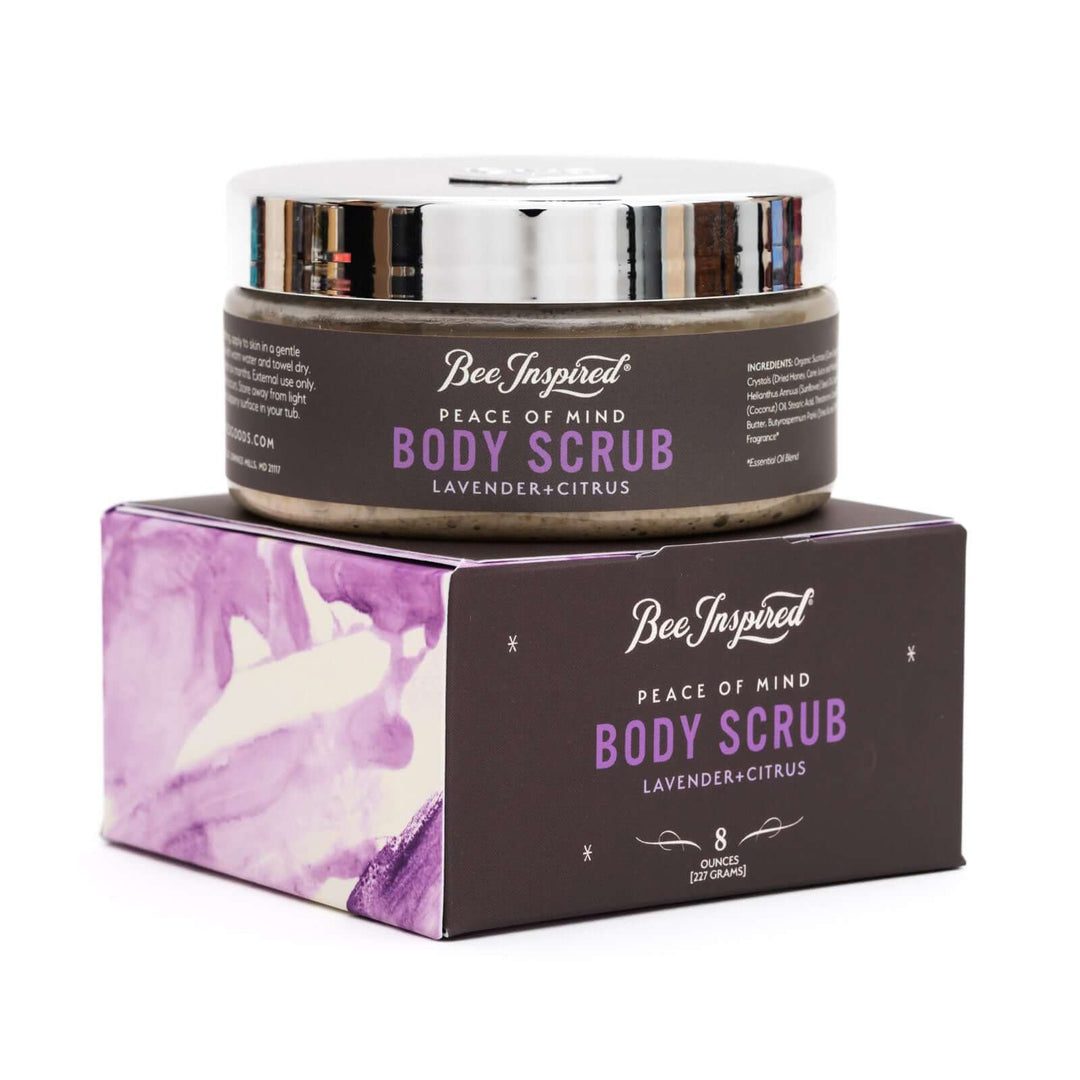
- Peace of Mind: lavender and citrus, herbal and bright. The most familiar of the four.
- Rose Garden: rose, soft lavender, and geranium. Floral and layered without tipping into perfume.
- Sea+Tea: coastal herbs and greenery. The green, slightly briny one in the lineup.
- Place in the Sun: summer fruit and laurel. Sweet and sun-warm with a green, leafy edge.
Work through them one at a time. Notice which scent you look forward to in the shower and which grain feels right under your hand. By the last jar, you’ll know which one is yours, and there’s a code inside the box for 25% off the full size when you’ve decided. It takes the guesswork out of the whole thing, which is a better way to spend $36 than gambling it on a single jar you might not love.

The Petite Body Scrub Sampler: four best-sellers in 2oz jars. Try all four, then take 25% off your favorite full size.
The Bottom Line
Price will always be part of the decision, and it should be. But the front of the jar and the price tag don’t tell you much. The ingredient list does. Flip it over, read the first few items, and you’ll know in about ten seconds whether you’re buying scrub or buying water with a nice label.
Our case is simple: a waterless, plant-rich formula, scented with essential oils, made in small batches in Maryland. If that’s what you’re after, the sampler is the easiest, lowest-risk way to find the one you’ll keep reaching for.

FAQs About Choosing a Good Body Scrub
What makes a good body scrub?
A good body scrub exfoliates without feeling harsh, leaves skin soft rather than stripped, and gets its scent from a real source like essential oils. The grain should break down as you work it in, and the oils should do enough that skin feels comfortable after you rinse. The ingredient list is the fastest way to judge all of this before you buy.
How can I tell if a body scrub is good quality?
Read the first two or three ingredients, since lists are ordered by weight. If water is near the top, much of the jar is water, which usually means added preservatives and fewer nourishing oils. A waterless, oil-rich formula scented with essential oils rather than synthetic parfum is a sign of a more concentrated product.
Why are some body scrubs so much more expensive than others?
Price often comes down to what fills the jar. Waterless formulas built on organic oils and butters cost more to make than water-based scrubs padded with fillers and synthetic fragrance. Small-batch production and essential oil blends add cost too. The ingredient list usually explains the price gap better than the label on the front.
Is a sugar scrub or a salt scrub better?
It depends on your skin and preference. Sugar grains tend to be finer and break down as you work them in, which many people find gentler. Salt scrubs are coarser and firmer. Neither is universally better; the quality of the oils and the rest of the formula matters more than sugar versus salt alone.
How do I choose a body scrub scent I will actually use?
Scent is hard to judge from a label or a quick sniff in a store. The most reliable way is to try a few at home over several showers and notice which one you reach for. Our Petite Body Scrub Sampler is built for exactly this: four 2oz jars to work through before you commit to a full size.