

A body scrub is a physical exfoliant — a product you apply to damp skin, work in with your hands, and rinse away. As you scrub, the abrasive particles in the formula lift dead cells from the skin's surface. What you're left with is softer skin texture and a clean that goes deeper than soap alone. It's one of the oldest forms of skincare, and the basic logic hasn't changed: grit plus oil plus water equals smoother skin.
The variables — what kind of grit, which oils, what scent, how coarse — are where products diverge. At Bee Inspired, those variables are defined by one thing we know well: honey.

What Goes Into a Body Scrub
Every body scrub is built from two components: an exfoliant that does the physical work, and a carrier — usually oil — that conditions the skin surface as you rinse. The ratio between them determines how the product feels on the skin and how much oil residue is left after rinsing.
The most common exfoliants are sugar and salt. Sugar granules are softer and dissolve in warm water as you work, which makes them better suited for frequent use and for areas of skin that don't need aggressive abrasion. Salt is harder and doesn't dissolve as quickly, which makes it more effective on thicker skin but harsher on skin that's already compromised or dry. Ground botanicals — walnut shells, blueberry seeds, pumice — can supplement the primary exfoliant and add texture variety within the same formula.
On the oil side, common base ingredients include sunflower oil, coconut oil, shea butter, cocoa butter, and almond oil. Each has different absorption and finish characteristics. Sunflower oil is lightweight and rinses relatively clean. Shea butter and cocoa butter are richer and leave more on the skin surface after rinsing. Most scrubs blend two or more to balance the rinse-off feel.
Fragrance — whether from synthetic fragrance oils or from essential oils — is almost always present. The distinction matters to some people. Essential oils are pressed or distilled from actual plant material; synthetic fragrance oils are manufactured compounds. Several of our formulas use essential oil blends; the Nectar+Honey Scrub uses a phthalate-free fragrance oil. The Original Honey Body Scrub uses no fragrance at all — it smells like honey because it is honey.

The Role of Honey in a Body Scrub
Honey is unusual as a skincare ingredient because it functions as both an exfoliant and a humectant. When honey crystallizes — the natural process where glucose separates from the liquid and forms solid crystals — those crystals have real abrasive texture. That's the basis of our Original Honey Body Scrub: one ingredient, pure crystallized honey, jarred as crystals rather than warming it back to liquid. There's nothing else in it. The crystals scrub off dead skin cells and dissolve as you work, leaving no film on rinsed skin.
In our multi-ingredient formulas, we use honey crystals — dried honey combined with cane juice and molasses — alongside organic cane sugar as a second exfoliant. This combination gives a more varied particle size than cane sugar alone and contributes the characteristic honey scent to unscented formulas. It's not a decorative ingredient. It's doing work.
If you want to go deeper on how honey functions as a skincare ingredient, our post on honey in skincare covers the ingredient itself in more detail.

Sugar Scrubs vs. Salt Scrubs vs. Enzyme Scrubs
Physical scrubs — sugar, salt, ground botanicals, pumice — work through friction. You're mechanically lifting dead skin cells. The strength of that friction depends on particle size, hardness, and how long you work the product into the skin.
Sugar scrubs sit at the gentler end of the physical exfoliant spectrum. Because sugar dissolves in warm water, the abrasion naturally decreases as you scrub — it gets gentler the longer you use it, rather than staying consistently aggressive. This makes sugar-based formulas well suited for skin that gets dry, for use more than once a week, and for areas like the backs of arms or shins that can handle regular exfoliation but aren't particularly tough.
Salt scrubs are harder and slower to dissolve, which makes them more effective for very rough patches — thick heel skin, for example — but less forgiving on skin that's irritated, recently shaved, or already stripped of moisture. Our sugar scrub vs. salt scrub comparison goes deeper on choosing between the two.
Enzyme exfoliants work differently: they break down the proteins that hold dead skin cells together rather than scrubbing them off physically. They're typically gentler and better tolerated by reactive skin. A body scrub and an enzyme exfoliant can be used in different contexts on the same person — it depends on the area and the skin's condition that day.
Our guide to why and how often to exfoliate goes into more detail on frequency and skin type considerations.

How to Choose a Body Scrub
The most useful variables to consider when choosing a scrub are particle coarseness, oil content, and scent source.
Particle coarseness determines how aggressively the product exfoliates. Fine-ground exfoliants — sugar, fine pumice, blueberry seeds — are better for regular use and for sensitive skin. Coarser particles — ground walnut shells, coarse salt — are more effective on very rough patches but shouldn't be used on facial skin or recently irritated skin.
Oil content and composition affects how the product rinses and what's left on your skin afterward. A scrub with a high butter content (shea, cocoa) will leave more residue than one built around lighter oils (sunflower, almond). If you're pairing the scrub with a body butter afterward, a lighter rinse finish is actually preferable — you want the butter to absorb into skin that's been prepped, not already coated.
Scent source matters most for people with fragrance sensitivity. Essential oil-based formulas derive their scent from plant material and may be better tolerated than synthetic fragrance blends. If you're not sure how your skin responds to a new product, our patch testing guide walks through how to test before committing to full-body use.
For a more direct comparison of what separates scrubs at different price points and production scales, read our candid look at quality vs. price and our post on small-batch vs. mass production.
The Bee Inspired Honey Body Scrub Line
All of our scrubs are hand-poured in small batches at our Owings Mills, Maryland facility. Each batch is checked for texture, scent, and consistency before it ships. The formulas share a common base — organic cane sugar, honey crystals, sunflower oil, coconut oil, shea butter, and cocoa butter — and diverge in their secondary ingredients and scent profiles.
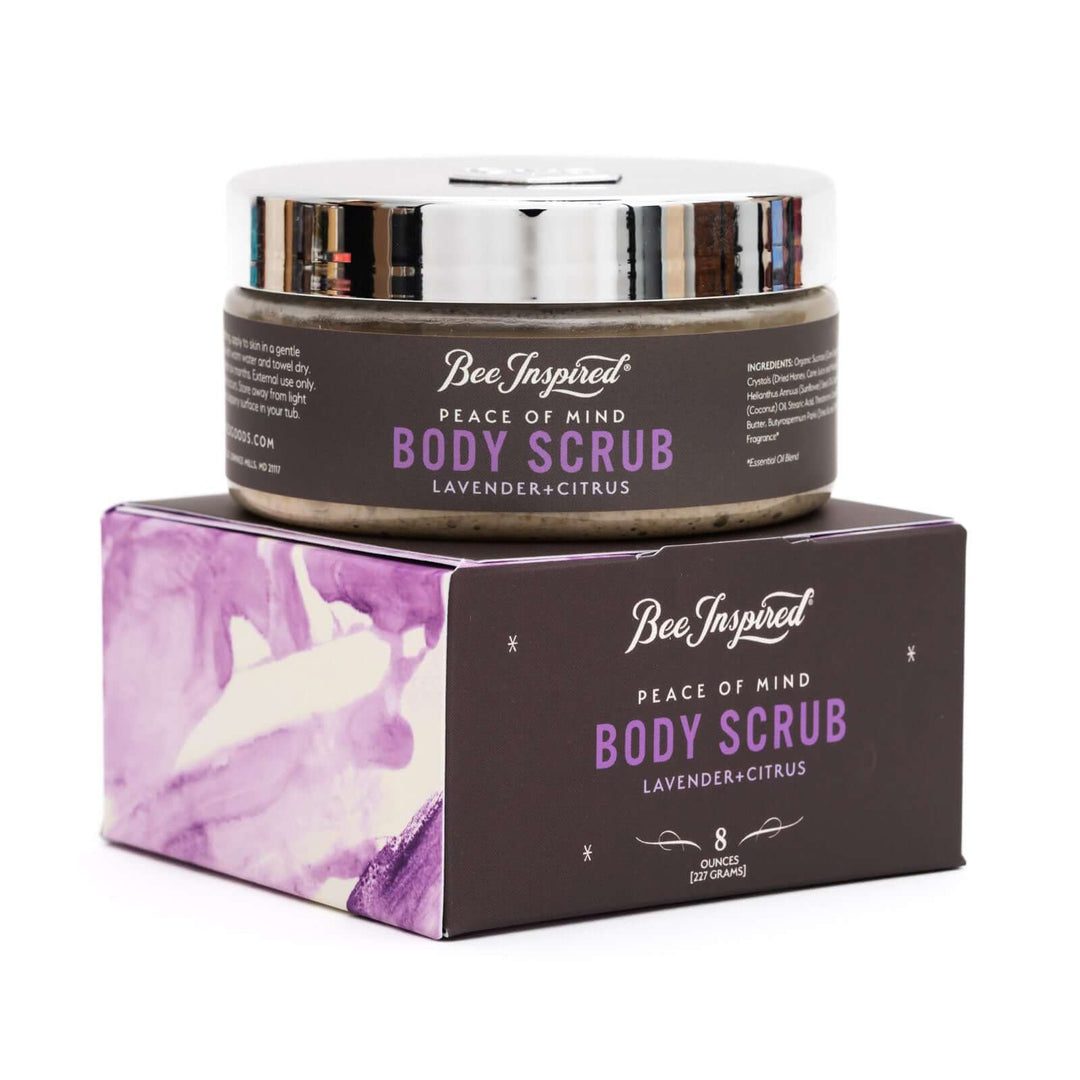
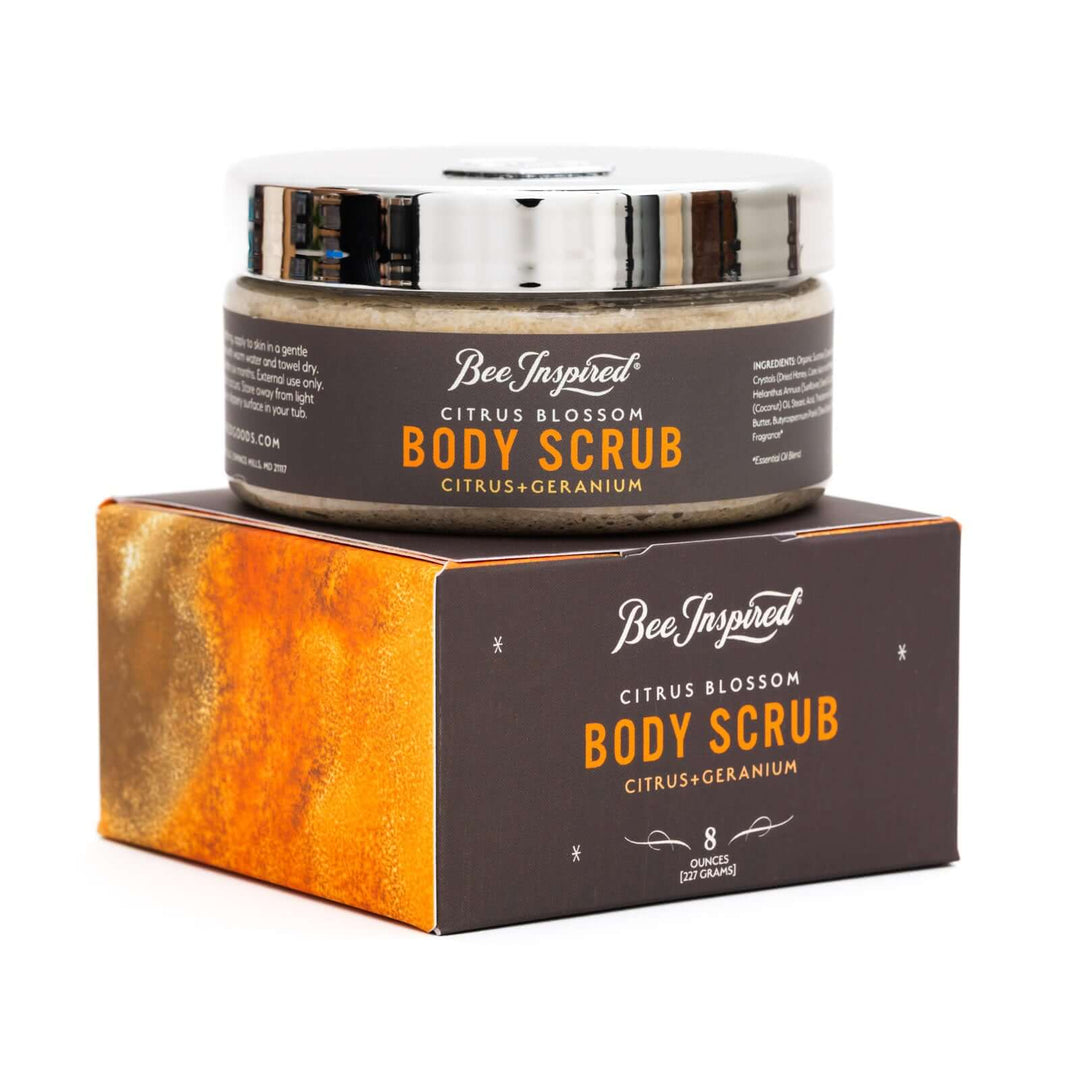
The Nectar+Honey Body Scrub leads with the honey fragrance — a warm, specific scent from a phthalate-free fragrance oil, not a generic sweet. The formula is 83.5% organic ingredients. The Peace of Mind Body Scrub uses Bulgarian lavender and citrus essential oils — pressed from actual plant material, not synthetic approximation. It's the one people reach for at the end of a long day. The Citrus Blossom Body Scrub pairs orange blossom and geranium essential oils — both floral-sourced, both distinct from the sharp synthetic citrus most people are used to.
The Place in the Sun Body Scrub adds real blueberry seeds and almond oil to the base, with a Summer Fruits and Laurel essential oil blend that reads as sun-ripened fruit and bay. The Autumn Harvest Body Scrub uses ground walnut shells alongside the sugar and honey crystals, and pumpkin seed oil in the base — scented with actual pumpkin, cinnamon bark, and whole clove essential oils. The Rose Garden Body Scrub includes dried rose petals visible in the jar, rose hip powder, rose hip oil, and jojoba oil — scented with rose, lavender, and geranium essential oils.
The Sea+Tea Body Scrub is our only 100% plant-derived formula — no honey crystals, no animal products. It combines fine-ground pumice, blueberry seeds, and cane sugar with sea clay, chlorella powder, and a coastal essential oil blend developed with the spa director at Cliff House Maine: yarrow, lavender, bergamot, and rosemary. Fine enough to use on facial skin. And the Original Honey Body Scrub — just crystallized honey, jarred as crystals, no fragrance, no oils, no additives. Face or body. One ingredient.
Browse the full honey body scrub collection to see all eight formulas.
Using a Body Scrub Correctly
The sequence matters. Apply to damp skin — not dry, not soaking wet — in slow circular motions. Damp skin gives the particles something to work with; soaking wet skin dilutes the formula too much. Focus on areas that tend to build up texture: heels, elbows, knees, backs of arms. Rinse with warm water and pat dry.
The window right after rinsing — when skin is still slightly damp — is the best time to apply body butter or cream if you're using one. Pairing a scrub with a matching body butter is the routine we recommend across the line. Each of our scrub formulas has a corresponding butter formulated to carry the same scent through after the shower.
For a full walkthrough of technique, timing, and how often to use a scrub by skin type, our post on how to use a body scrub covers all of it. And if you're curious about dry brushing as a complement or alternative to wet exfoliation, we have a separate post on dry brushing that walks through how it's different.
Make Your Own
If you want to try a honey body scrub before buying, or just want to understand what goes into a formula by making one yourself, we have two DIY posts in the blog. The DIY honey body scrub walks through a basic formula you can make with pantry ingredients. The honey oat scrub is a gentler variation that works well for reactive skin.


FAQs About Body Scrubs
What does a body scrub do?
A body scrub physically removes dead skin cells from the skin's surface through friction. The result is smoother skin texture and a cleaner surface. Most formulas also leave a light coating of oil on the skin after rinsing, which contributes to the softer feel.
What is the difference between a sugar scrub and a salt scrub?
Sugar granules dissolve in warm water as you work, so the abrasion decreases naturally over the course of use — making sugar scrubs gentler and better suited for regular use. Salt is harder and dissolves more slowly, making it more effective on very rough patches but harsher on dry or sensitive skin.
How often should you use a body scrub?
For most people, two to three times a week is sufficient. If your skin tends to be dry or reactive, once a week is more appropriate. The right frequency is the one that leaves skin feeling smoother without feeling stripped or irritated.
Can you use a body scrub on your face?
Some can. Our Original Honey Body Scrub — pure crystallized honey — is gentle enough for facial use and is used that way by many of our customers. Our Sea+Tea Body Scrub, which uses fine-ground pumice rather than coarser abrasives, is also formulated fine enough for the face. Coarser scrubs with walnut shells or larger sugar crystals are better kept to body use only.
What should you use after a body scrub?
A body butter or cream applied to still-damp skin immediately after rinsing. The skin surface is prepped and slightly open to absorption, which makes that the most effective time to apply a moisturizer. Each of our scrubs is paired with a corresponding body butter formulated to carry the same scent profile through after the shower.
Is honey good in a body scrub?
Honey crystals are an effective physical exfoliant that dissolves in warm water as you work — similar to sugar but with a distinct texture and scent. Honey is also hygroscopic, meaning it draws moisture from the air. In a rinse-off product, the crystal structure does the primary work. The Original Honey Body Scrub is built entirely around this: pure crystallized honey, nothing else.