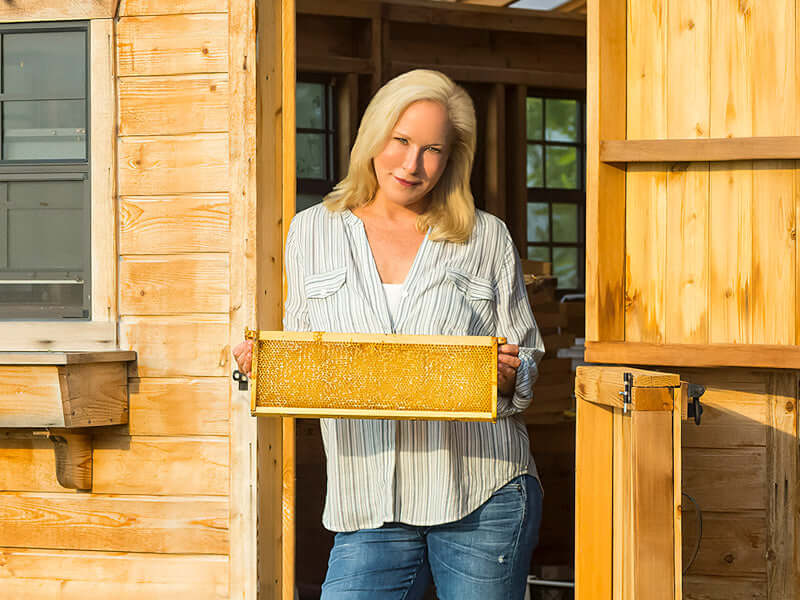


Dale announced, “You’ve been robbed.”
When I arrived at the farm on July 13th, the acres of bright yellow sunflowers we planted for the bees were in full bloom. But as I passed the bee yard, something stopped me cold. One of the hives was short.
Somewhere between July 4th and July 13th, a beekeeper with access to our gated farm walked off with a nearly full honey super from my most productive hive. This was not a smash-and-grab. The thief disassembled the hives, examined the frames one by one, worked out which held the most honey, then lifted the bottom super closest to the brood, the heaviest one, from my best colony. Whoever did this knew exactly what they were doing.

Our Plastic-Free Honey Lip Balm is made with real honey and beeswax.
At least they cared enough about the bees to put everything back together and leave the hives in proper order.
If you have been following my beekeeping adventures, you know I had a stroke of beginners luck with my first honey harvest. But any hope of more honey this season was gone. The bees would need everything left in those frames to make it through the winter. Honey production winds down once the plants stop blooming, and after that the colony is living on its savings.

This had to be an inside job. Someone who knows us. Someone with access to the farm: an employee of one of the companies that services the property, or a family member or friend of one.
For the first time without my mentor, Dale, I suited up. My friend Joyce Wallace assisted while her sister Barbara documented every move. We carried over an extra super of drawn comb I had been saving for the following week’s second harvest. But when I cracked open the hive, the wall of bees that had blanketed the front the week before was simply not there.


Half the colony was gone.
There is a passage in The Beekeeper’s Lament by Hannah Nordhaus where beekeeper John Miller puzzles over why anyone would steal bees at all. He compares it to stealing a toddler: you are really just making more work for yourself. Bee theft takes know-how. A thief has to understand the craft well enough to open a hive, read the frames, and walk away unscathed.
Here is the single most useful thing I took from this: brand your hives. Burn or engrave your name, address, and phone number onto every hive part, inside and out, in more than one spot. If a thief covers your markings, they will almost certainly miss the ones tucked inside.
Then I started making calls. I phoned every vendor that provides services to the farm, and within 24 hours I had reached four of them. I warned each one I was about to ask the strangest question they had heard all year: “Do you have any beekeepers on your staff?” Every time, a long pause followed. One man answered instantly: “No, but I have two guys who land in the hospital if they get stung.”
Each call asked me to be warm and watchful at once, so every owner understood I was gathering facts, not pointing fingers. One pointed me toward another vendor whose crew had been on the property a lot that month. So I asked the questions a detective would: How often were the men seen here? How many of them? How many trucks, what color, what logos, and where did they park? I called that fifth company, waited nearly a week, and finally got a flat “not us.”
From there I did my homework on who to notify: agricultural crime units and anyone in local law enforcement who handles farm theft. I also called the bee inspector for our area and set up an appointment, both to register my hives and to learn more about the state of beekeeping in my county.
If you or anyone you know has information about my stolen hive, please reach out through the contact button. And if this story might reach the right person, please share it.
Caring for this land and these communities is at the core of who we are. It’s why we created Roots & Wings, our giving initiative that connects every purchase to something that matters. See how we give back.

FAQs About Who Stole My Bees? Inside a Beehive Theft on Our Maryland Farm
Why would someone steal bees or honey from a hive?
Honey has real value, and so do strong colonies. A full honey super represents months of work and can be sold or used directly. Established hives with drawn comb and a laying queen are also worth money to someone who wants to expand quickly. Because opening and moving a hive takes real skill, bee theft is almost always committed by someone who already knows beekeeping.
How can I protect my beehives from theft?
Brand or engrave your name, address, and phone number on multiple hive parts, both inside and out, so your markings survive even if a thief covers the outside. Keep hives in view of your home or a camera where possible, use locks or ratchet straps on lids, and register your colonies with your state so there is an official record. Photograph your equipment and note any identifying marks.
Should I register my beehives?
In Maryland and many other states, registering your colonies with the Department of Agriculture is required, and it has real benefits. Registration creates an official record of your hives, connects you with your local bee inspector, and supports disease monitoring across the region. That record can also help if your equipment is ever stolen or disputed.
When does honey production end for the season?
Honey production winds down once the surrounding plants stop blooming, which on the Eastern Shore generally means late summer into fall. After the final bloom, bees rely on the honey they have already stored to feed the colony through the winter, so beekeepers leave those late-season frames in place rather than harvesting them.