

There is a moment each summer — two weeks, sometimes less — when basswood trees bloom. Their small yellowish-white flowers open in pendant clusters, fill with nectar on cool dewy mornings, and pull bees into a sustained frenzy of foraging. Then it is over. The bloom closes, the nectar is gone, and whatever the bees managed to collect in that narrow window is all there will be until next year. That constraint is the entire reason basswood honey exists the way it does: rare, intensely flavored, and unlike anything else in a well-stocked pantry.

Basswood honey — also called linden honey in many parts of the world — is a monofloral honey, meaning it comes primarily from a single floral source. The tree itself goes by several names: basswood in North America, linden across Europe, lime tree in the UK. All the same species, all producing the same remarkable nectar. What the bees make from it is a honey that consistently surprises people who try it for the first time. The pale color suggests something mild. The flavor is the opposite.
The Basswood Tree and Its Bloom
Basswood trees are native to the northern hemisphere and grow widely across the upper Midwest, the Great Lakes region, and into the Northeast. They are large, long-lived trees with heart-shaped leaves and a distinctive drooping bloom that appears in late spring to early summer — typically June into early July depending on the region and the year's weather. The flowers are small but numerous, and on the right morning they produce nectar in abundance.
What makes basswood particularly interesting to beekeepers is the relationship between bloom timing and nectar production. Cool nights followed by warm mornings drive the highest nectar flow. On those mornings, a hive stationed near a stand of basswood trees will send out foragers in numbers that look almost frantic. The bloom window is short enough that beekeepers who work it have learned to pay close attention — miss the peak by a week and the opportunity is gone.
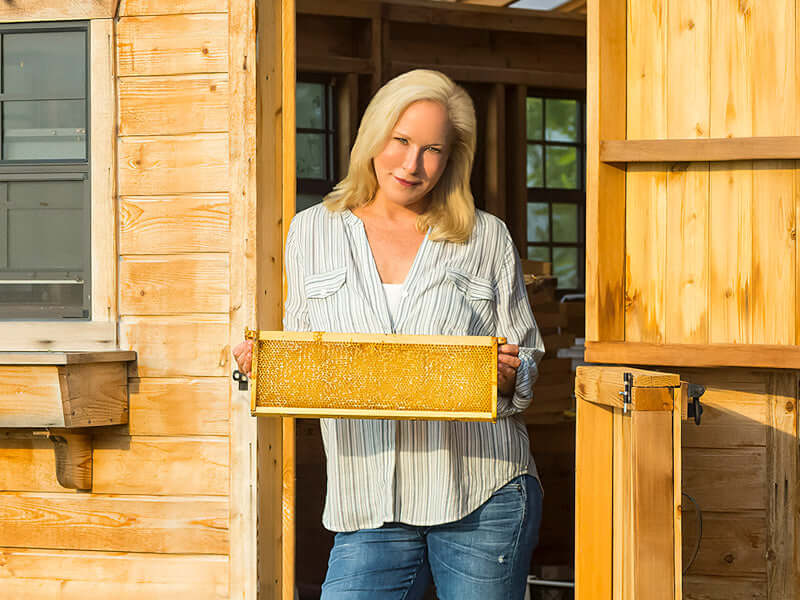
Kara planted a basswood tree at the center of the Bee Inspired apiary specifically to observe this dynamic firsthand. The first year it bloomed, one of her hives swarmed to it. Twice. That's not an accident — that's bees recognizing something worth working.

What Does Basswood Honey Taste Like?
Basswood honey has a flavor profile that doesn't match its appearance. The color runs pale — greenish-gold when freshly harvested, clearing to a luminous yellow-amber as it settles — and light-colored honeys tend to be mild. Basswood is not mild. It is intensely herbal, with notes of sweet hay and a whisper of menthol that shows up in the finish. Some tasters pick up a faint lime quality. The sweetness is present but restrained; it doesn't dominate the way a clover honey or a wildflower blend might.
The combination of high intensity and light color is genuinely unusual in honey. Most honeys that taste this complex are dark — buckwheat, chestnut, manuka. Basswood achieves that depth of character while staying pale, which is part of why experienced honey tasters consider it one of the more distinctive varietals available.
The aroma carries the same herbal character as the flavor. Open a jar of good basswood honey and you notice it before you taste it — a clean, slightly green, almost floral-herbal scent that sets it apart immediately from conventional honey.

Basswood Honey vs. Other Varietals
If you're used to wildflower honey or clover honey, basswood will be a noticeable departure. Wildflower is variable by nature — its flavor shifts with the season and the region, reflecting whatever happened to be blooming. Clover is mild, clean, and approachable. Basswood is neither of those things. It is specific, assertive, and consistent in its herbal character from jar to jar in a way that monofloral honeys tend to be.
Compared to other rare monoflorals: tupelo honey is silky and floral with a slow crystallization rate, often considered the most refined American varietal. Sourwood is warm, anise-adjacent, distinctly Appalachian. Basswood sits in a different category — more herbal than either, more surprising, with an intensity that makes it the honey people reach for when they want something that actually contributes flavor rather than just sweetness.

Why Is Basswood Honey So Hard to Find?
Three factors converge to make genuine basswood honey scarce. First, the bloom window is short — two weeks in most regions. Second, basswood trees require specific growing conditions and are concentrated in particular northern regions rather than distributed broadly across the country. Third, producing a true monofloral batch means having enough basswood in bloom near enough hives at the right moment to collect predominantly basswood nectar rather than a blend. Miss any one of those conditions and you end up with wildflower honey, not basswood.
The result is that even beekeepers who work basswood country don't produce it every year. A late frost, a dry spring, an off-bloom year — any of these can reduce the nectar flow enough that a monofloral harvest isn't possible. It's the kind of honey that, when it shows up, tends to sell out quickly among the people who know what it is.
How to Use Basswood Honey
The intensity of basswood honey means it works best where you want the honey to be noticed rather than just present. In tea, it harmonizes particularly well with chamomile, mint, or any blend where herbal character is already part of the profile — it deepens rather than competes. Over Greek yogurt, the herbal complexity cuts through the tang in a way that milder honeys don't. On a cheese board paired with aged cheese, it creates the kind of contrast that makes people stop mid-bite and ask what that is.
In cocktails and mocktails, basswood is a strong choice when you want actual honey flavor rather than generic sweetness — the herbal notes carry through even alongside spirits and citrus. Try our Basswood Honey Martini recipe for a herbal cocktail. In our Chocolate Almond Milk Smoothie, it is strong enough to stand its ground even against the cocoa powder.
Basswood Honey can also be used in baked goods that welcome the herbal character and intensity of it. The coconut in our Coconut Macaroons goes well with the almost hay-like flavor from the Basswood Honey. The fragrant lavender in our Lavender Scones works perfectly with the complexity of basswood. By the spoonful is worth doing at least once, slowly, to understand what you're working with. A little goes a long way; the intensity means you need less than you think.

Does Basswood Honey Crystallize?
Minimally filtered basswood honey will crystallize over time, as all minimally filtered honey does. Basswood tends to crystallize more slowly than many other varietals, but it will eventually set. This is a sign that the honey is genuine and unprocessed — heated and filtered commercial honey resists crystallization because the processing that makes it shelf-stable also strips out the natural particles that seed crystal formation.
If your basswood honey crystallizes, warm the jar gently in hot water — not boiling, not microwaved — until it returns to liquid. The flavor and character come back intact.
Our linden basswood honey is raw and minimally filtered, Star K Kosher certified, and sourced from northern region beekeepers during the narrow bloom window. If you've been looking for a honey that's genuinely different from what you keep in the cabinet, this is worth trying.

FAQs About Basswood Honey
Is basswood honey the same as linden honey?
Yes. Basswood and linden refer to the same tree — Tilia americana and its European relatives. In North America the tree is most commonly called basswood; in Europe and the UK it's called linden or lime tree. The honey produced from any of these is essentially the same varietal, with the same herbal, menthol-adjacent flavor profile.
Where does basswood honey come from?
In the United States, basswood honey comes primarily from the northern Midwest and Great Lakes region, where mature basswood trees grow in sufficient density to support a monofloral harvest. It is also produced in parts of Eastern Europe, particularly Poland, Hungary, and Ukraine, where linden trees are more widespread and the varietal has a longer commercial history.
What does basswood honey taste like?
Intensely herbal, with notes of sweet hay and a hint of menthol in the finish. Some tasters pick up a faint lime quality. The sweetness is present but not dominant. The flavor is more complex than the pale color would suggest.
Is basswood honey good for cooking?
It is, particularly in applications where the honey's character can come through — herbal teas, dressings, glazes, specialty cocktails. Because the flavor is assertive, it's worth thinking about what you're pairing it with. It doesn't disappear into a recipe the way a mild clover honey does, which is either an asset or something to plan around depending on what you're making.
How should I store basswood honey?
At room temperature, away from direct sunlight and heat. No refrigeration needed — honey stored correctly has an essentially indefinite shelf life. If it crystallizes, gentle warming in hot water will restore it.