

Most people encounter honey that's golden, mild, and sweet in a way that doesn't demand much attention. Buckwheat honey is the opposite. It's nearly black, intensely aromatic, and has a flavor that stops people mid-bite — molasses-forward, malty, earthy, with a richness that doesn't fade quickly. It's not a honey that blends into the background, and that's exactly why it has such a devoted following among people who cook seriously and eat with intention.

Buckwheat honey is a monofloral varietal, meaning bees produce it primarily from one plant source: the nectar of buckwheat blossoms. The relationship between buckwheat plants and honeybees is a close one, and it's worth understanding because it explains everything distinctive about this honey — the color, the flavor, the scent, and why it's harder to find than most.
The Buckwheat Plant and the Bees That Work It
Buckwheat (Fagopyrum esculentum) is not a grain. Despite the name, it's not related to wheat at all — it's a flowering plant in the same family as rhubarb and sorrel. It's grown primarily as a cover crop and grain substitute across the northeastern United States, where the climate and soil conditions suit it well. The plant grows quickly, blooms in summer, and produces dense clusters of small white flowers that are highly attractive to bees.
Those flowers are where the story gets interesting. Buckwheat blossoms produce nectar with a high sugar concentration, and they produce a lot of it in a short window. When a buckwheat field is in full bloom, bees will prioritize it heavily — flying in from considerable distances to work the flowers. The nectar they collect is darker and more mineral-rich than what you'd get from clover or wildflower sources, and that character carries all the way through to the finished honey.
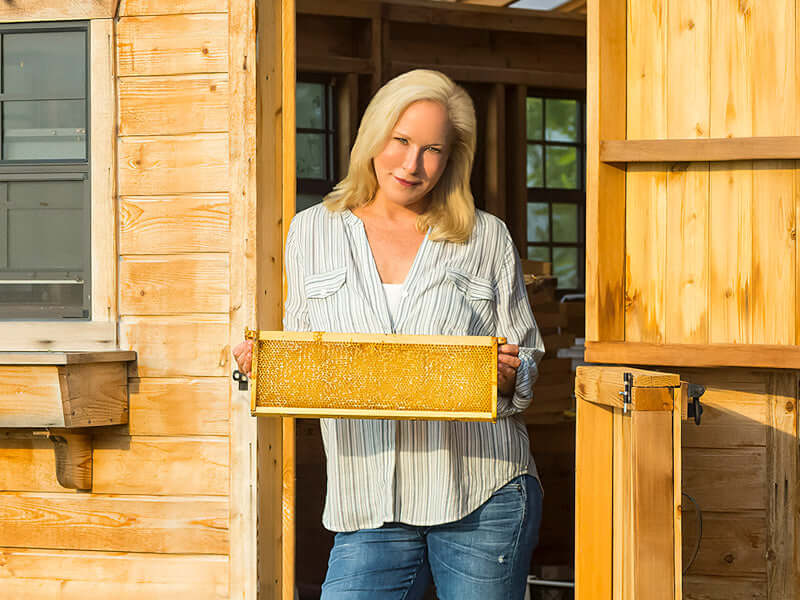
At Chesterhaven Beach Farm on Maryland's Eastern Shore, Kara grows buckwheat as part of the farm's broader forage landscape. Her bees don't work buckwheat exclusively — when buckwheat is blooming alongside clover, wildflowers, and other summer sources, it becomes one part of what the hives are foraging. That buckwheat presence is part of what makes the farm's seasonal honeys — Spring, Summer, and Autumn — carry the depth they do.. The result shows up in the honey's depth in a way that single-crop monocultures don't always capture.
The buckwheat bloom is brief, which is part of what makes this honey less common than lighter varietals. Once the flowers are finished, that nectar source is gone for the season. Beekeepers and honey producers who supply buckwheat honey in any real volume need to plan around that window carefully.

What Does Buckwheat Honey Taste Like?
The most honest comparison is dark molasses — not just similar, but genuinely close. Buckwheat honey has that same deep, almost bitter-edged sweetness with a malty undertone that lingers. There's earthiness underneath it, something that reads almost mineral or grainy. It finishes with more complexity than it starts with.
People who love dark beer tend to respond immediately to buckwheat honey. The flavor logic is similar: rich, fermented-adjacent, with a roasted quality that you don't find in any lighter honey. If your palate runs toward strong coffee, aged cheese, or dark chocolate, buckwheat honey fits naturally into how you already eat.
It's not a subtle honey. Used raw, it will be the loudest thing on a cheese board. Stirred into tea, it doesn't disappear the way a clover honey would — you'll taste it in every sip. That's a feature, not a flaw, but it's worth knowing so you can use it intentionally rather than reaching for it when you want something neutral.
What Does Buckwheat Honey Smell Like?
The scent is pungent, earthy, and musky — unmistakably farm-like in a way that some honeys never are. Open a jar and you get something that smells less like flowers and more like a working landscape: hay, grain, dark soil, with the molasses note underneath. It's not delicate. It smells exactly like it tastes.
For some people, the aroma is an adjustment if they're used to lighter honeys. For others, it's immediately compelling — the smell of something that wasn't manufactured to be mild. Either way, the scent is a reliable preview of the flavor. If you hold a jar of buckwheat honey and find the aroma interesting, you're going to like eating it.

What Does Buckwheat Honey Look Like?
Dark amber to nearly black, depending on the batch and how the light hits it. It's one of the darkest honeys you'll find anywhere. The color comes from the concentration of compounds in buckwheat nectar — the same ones that give it its characteristic flavor and aroma. As a general rule in honey, darker color signals a bolder flavor profile, and buckwheat honey is the clearest example of that pattern.
Does Buckwheat Honey Crystallize?
Yes, and it does so fairly quickly compared to other minimally filtered honeys. When buckwheat honey crystallizes, it sets into a thick, dense paste rather than the fine-grained texture you'd see in something like clover honey. The paste is still completely usable — it spreads well and dissolves into hot liquids without any issue — but the texture is noticeably different from liquid honey.
Crystallization is a sign of real, minimally filtered honey. It happens because minimally filtered honey retains its natural glucose, which is less soluble than fructose and will eventually solidify. If you want to return buckwheat honey to liquid, set the jar in warm water — not hot, not microwaved — and let it come back slowly. The flavor and quality are unchanged.

How to Use Buckwheat Honey
The flavor profile points toward a specific set of uses, and buckwheat honey performs best when you lean into its boldness rather than trying to use it the way you'd use a mild wildflower honey.
Baking: This is where buckwheat honey really earns its place. Because its flavor is so close to molasses, it substitutes directly in recipes that call for dark sweeteners — gingerbread cookies, banana bread, banana yogurt muffins, spice cake. It adds depth without being one-dimensional, and it keeps baked goods moist. Use it anywhere the recipe is already asking for something with character.
Savory cooking: BBQ glazes and marinades for smoked or grilled meats are a natural fit. The earthiness in buckwheat honey holds up to smoke and char in a way that lighter honeys don't. It also works well in vinaigrettes where you want sweetness with weight behind it.
Cheese pairings: Aged cheddar, sharp goat cheese, blue cheese — anything with a strong flavor that can match the honey rather than get overwhelmed by it. Drizzled over a cheese board, buckwheat honey tends to be the thing people ask about.
Hot drinks: Stirred into black tea or a strong coffee, buckwheat honey adds sweetness and a layer of roasted, malty flavor that lighter honeys can't replicate. It's one of the few honeys that doesn't get lost in a bold drink.
Raw, on its own: On toast with good butter, or straight off a spoon if you want to understand what you're working with. The flavor is most direct this way, and it's a good starting point before you start cooking with it.

Is Buckwheat Honey the Same as Regular Honey?
Buckwheat honey is honey. It is produced by honeybees from flower nectar in the same way all honey is made. What makes it different is the source. "Regular" honey, if we're comparing it to something like clover or wildflower, comes from lighter, more neutral nectar sources. Buckwheat nectar is more concentrated and mineral-rich, and that's what produces such a dramatically different result in the finished honey.
The production process is the same. The bees are the same. The plant is where everything diverges.
Is Buckwheat Honey Rare?
Relatively, yes. Buckwheat is grown less widely than it once was, and the bloom window is short. That limits how much buckwheat honey any producer can bring in during a season. It's not impossible to find, but you won't see it at every grocery store the way clover honey is stocked. Small-batch producers who plan around the bloom and source carefully are the most reliable place to find it.
Our buckwheat honey is sourced primarily from northeastern US beekeepers who work buckwheat fields during the summer bloom, and we keep it available year-round by purchasing in bulk during the season. When it's gone, it's gone until the next harvest.
If you want to put buckwheat honey to work at breakfast, our hot buckwheat cereal recipe is a straightforward starting point.
If you're ready to cook with it, our Buckwheat Honey is available in 11 oz glass jars, Star K Kosher certified, and packed exactly as it came from the hive.


FAQs About What Is Buckwheat Honey?
What is buckwheat honey?
Buckwheat honey is a monofloral honey produced by bees that forage primarily on buckwheat blossoms. It’s one of the darkest honeys available, nearly black in color, with a bold, malty, molasses-like flavor and a pungent, earthy aroma. It’s minimally filtered, and noticeably different from lighter varietals like clover or wildflower honey.
Is buckwheat honey better than regular honey?
That depends on what you're using it for. Buckwheat honey has a much bolder, more complex flavor than mild varietals, which makes it better for baking, savory glazes, and strong drinks where you want the honey to actually come through. For someone who prefers a delicate, neutral sweetness, it may be too intense. It's a different tool, not a universally better one.
What does buckwheat honey taste like?
Rich, malty, and deeply sweet in a way that resembles dark molasses. There's an earthy undertone and a slight mineral quality underneath. The flavor is bold and lingers — it doesn't fade quickly the way lighter honeys do. People who gravitate toward dark beer, strong coffee, or aged cheese tend to take to it immediately.
Is manuka honey the same as buckwheat honey?
No. Both are monofloral honeys with strong flavor profiles, but they come from entirely different plants in different parts of the world. Manuka honey is produced from the manuka shrub native to New Zealand. Buckwheat honey comes from buckwheat plants grown primarily in the northeastern United States and parts of Europe. The flavor, color, and character of the two are quite different.
Does buckwheat honey crystallize?
Yes, and it crystallizes on the faster side compared to many other minimally filtered honeys. It sets into a thick, dense paste. To return it to liquid, place the jar in warm water and let it warm gradually. Do not microwave it. The quality and flavor are not affected by crystallization.
Is buckwheat honey good for baking?
It's excellent for baking, particularly in recipes that already call for dark sweeteners like molasses or brown sugar. Gingerbread, dark breads, spice cakes, and bran muffins are natural fits. It adds depth and keeps baked goods moist. Use it anywhere you want sweetness with a layer of complexity underneath.
Where does buckwheat honey come from?
Buckwheat honey is produced primarily in the northeastern United States, where buckwheat is commonly grown as a cover crop and grain source. The plant blooms in summer, and the honey harvest follows the bloom. Our buckwheat honey is sourced from northeastern US beekeepers who work buckwheat fields during that window.