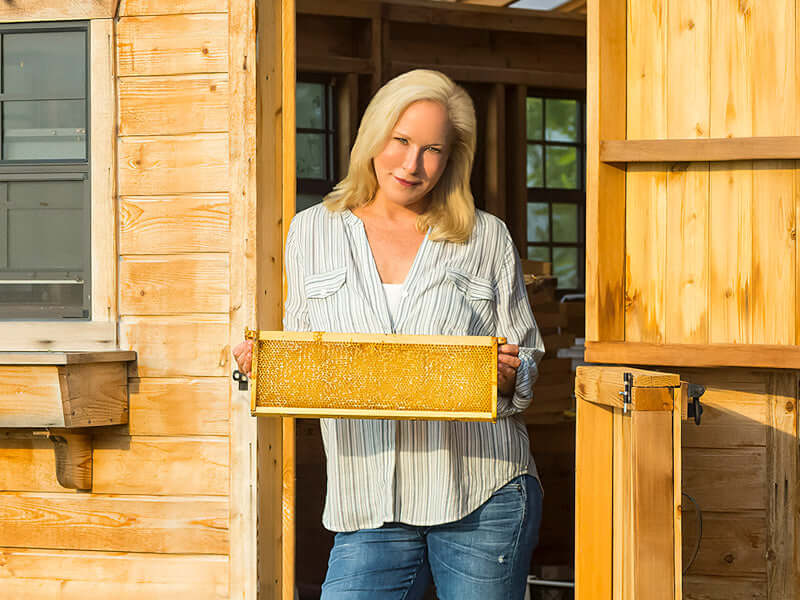


The first time you really look at a piece of honeycomb, not glance at it but actually study it, something happens. Every cell, perfectly six-sided. Every wall, the same length. Every angle, exactly 120 degrees. Thousands of cells, identical, fitted together without a single gap. It looks designed. It looks impossible. And it has been quietly hiding one of the oldest unsolved questions in mathematics for more than 2,000 years.

Why a hexagon? Why not circles, or squares, or some pleasingly random shape? Generations of philosophers, naturalists, and mathematicians have asked exactly that, and the answer turns out to be far more interesting than the bees themselves. The story stretches from a Roman farm manual in 36 BC to a mathematical proof finalized in 1999, with stops at Charles Darwin’s desk, a lava field in Northern Ireland, the north pole of Saturn, and a beehive on the Eastern Shore. Pull up a chair. This one is worth the trip.

A 2,000-Year-Old Math Problem, Hiding in a Beehive
The oldest known mention of the honeycomb’s mathematical puzzle comes from a Roman scholar named Marcus Terentius Varro, who in 36 BC included a curious note in his agricultural treatise Rerum Rusticarum Libri Tres. He laid out two competing theories about why honeycomb cells are six-sided. The first was charmingly literal: bees have six legs, so naturally they prefer six-sided rooms. The second came from the geometricians of the day, who argued that hexagons enclose the greatest amount of space within a given perimeter.
Roughly four centuries later, the Greek mathematician Pappus of Alexandria revisited the question in his work Synagoge. Pappus reasoned that of all the regular polygons that tile a flat plane without leaving gaps (triangles, squares, and hexagons), the hexagon encloses the most space using the least material. He famously credited the bees with “a certain geometrical forethought.” It was a compliment, but also a wild understatement. Pappus had glimpsed something true, but he could not yet prove it.
And so the puzzle sat there, half-answered, for the next 1,600 years. Mathematicians called it the Honeycomb Conjecture: the idea that of all the possible ways to divide a flat surface into regions of equal area, the regular hexagonal grid uses the shortest total length of dividing walls. Easy to state. Maddeningly hard to prove.

The Conjecture That Wouldn’t Quit
In the 17th century, Polish mathematician Jan Brozek picked up the thread, using a version of the theorem to explain why bees build hexagonal cells in the first place. By the time Charles Darwin came along in the 1800s, the honeycomb had become a kind of test case for the new theory of evolution by natural selection. Darwin called the honey bee’s comb-building ability “the most wonderful of all known instincts” in On the Origin of Species, and he was openly worried about it. If natural selection could not explain how a small insect produced something so perfectly geometric, his entire theory was in trouble.
Darwin’s answer, after years of experiments at his home in Kent, was an “economy of wax.” Bees that wasted less wax left more honey for the colony, which meant more bees, which meant more wax-thrifty bees over time. The hexagon, he argued, was simply what happened when the most efficient comb-builders kept passing their habits along.
Mathematicians, meanwhile, were still trying to nail the geometry down. In 1943, Hungarian mathematician László Fejes Tóth proved a special case of the conjecture, showing that the hexagonal grid is the most efficient way to divide the plane if the cells are required to be convex polygons with straight sides. Brilliant work, but it left a loophole. What if the cells could bulge? What if curved walls could somehow do better?

1999: A Proof, At Last
The loophole stayed open for another 56 years. Then, in June 1999, American mathematician Thomas Hales of the University of Michigan announced a complete proof of the Honeycomb Conjecture. Hales showed that even if you allow the cell walls to curve, bulge, or do anything else they please, the regular hexagonal tiling still wins. His reasoning was elegantly intuitive: every time a wall bulges outward to enlarge one cell, it must bulge inward to shrink the neighboring cell, and the math of those trade-offs always favors straight walls and 120-degree angles.
Hales, who had also recently solved Kepler’s conjecture about the densest way to pack spheres, had quietly closed the book on a 2,000-year-old question. The bees, as it turned out, had been right all along. The Honeycomb Conjecture is now properly called the Honeycomb Theorem, and the answer is the one Pappus suspected all those centuries ago: among all the ways to divide a plane into equal-area cells, the regular hexagon uses the least material to enclose the most space.

So How Do the Bees Actually Know?
Here is where the story gets genuinely strange. Bees almost certainly do not understand geometry. They do not run optimization algorithms or measure angles. So how do they consistently produce something a mathematician could not formally prove until 1999?
For most of history, the assumed answer was instinct, full stop, an ancient unexplained behavior passed along through generations. But research over the past few decades has revealed something far more interesting. In 2013, engineer Bhushan Karihaloo and colleagues at Cardiff University published a study in the Journal of the Royal Society Interface showing that bees do not actually start with hexagons. They start with circles.
When the researchers interrupted bees mid-build, they found cells that were perfectly circular in cross-section, little tubes shaped by the curve of the bee’s body. As the bees worked the wax with their own body heat, the soft wax flowed at the junctions where three circular walls met, settling into the 120-degree angles that produce a hexagon. Surface tension, the same force that pulls a soap bubble taut, did the geometric heavy lifting. The bees built circles. Physics finished the job.
This was a striking discovery, but it does not mean the bees deserve no credit. They still place each cell with remarkable precision, maintain the right wax temperature, and coordinate construction across a comb that may have thousands of cells being built at once from multiple starting points. A 2024 study highlighted in Scientific American showed that honey bees adapt cell size and seamlessly merge separate comb grids in ways that still surprise researchers. The geometry is partly written by physics, partly by the bee, and partly by 30 million years of evolution pressing on both.

Why a Hexagon and Not a Circle or a Square?
To really feel why the hexagon wins, it helps to picture the alternatives. Imagine trying to pack a flat surface with circles. They are space-efficient individually, but they leave little curved gaps wherever they touch. Now picture squares: they tile perfectly with no gaps, but they enclose less area for the length of wall used, and their corners create stress points. Triangles? Same problem, and worse.
The hexagon sits in an exquisite mathematical sweet spot. It is one of only three regular polygons that can tile a flat plane without leaving any gaps (the other two being triangles and squares), and of those three, it uses the shortest total wall length per unit of area enclosed. For a bee, that translates directly into wax saved, which translates into honey saved, which translates into colony survival. By one widely cited estimate, bees must consume roughly eight ounces of honey to produce just one ounce of wax. Every unnecessary wall is a tax on the colony.
The hexagonal structure is also remarkably strong. Because each cell shares all six of its walls with neighbors, forces are distributed evenly across the comb. The finished honeycomb can support roughly 30 times its own weight in stored honey. Engineers have borrowed this trick for everything from aircraft panels to skateboard decks to lightweight architectural cladding.

Hexagons Hiding Everywhere in Nature
Once you start looking, you find hexagons in the most unexpected places, and most of them have nothing to do with bees.
The Giant’s Causeway on the coast of Northern Ireland is made of roughly 40,000 stone columns, the majority of them six-sided. So is Devils Postpile in California. Both formed the same way: when thick basalt lava cools and contracts, the surface cracks to release tension, and the most energy-efficient crack pattern meets at 120-degree angles. That is the interior angle of a regular hexagon. Cool slowly enough, and the rock organizes itself into hexagonal columns without any biology involved at all.
Snowflakes form their familiar six-pointed shape because water molecules naturally arrange into a hexagonal lattice when they freeze. Insect compound eyes are made of tiny hexagonal facets, packed for maximum light-gathering with minimum cell material. Even Saturn’s north pole has a hexagon: a persistent six-sided jet stream first spotted by the Voyager spacecraft in 1981 and studied for years by the Cassini mission. It is wider than Earth, and scientists are still working out exactly why it forms.
The pattern is the same wherever it appears. When nature needs to divide space efficiently, distribute stress evenly, or pack things tightly together, it tends to land on the hexagon. The bees did not invent the shape. They were just the first to put it to work in such a beautifully organized way.

Holding 30 Million Years in Your Hand
This is the part that always stops us. Every jar of our honey began its life inside one of these tiny mathematical masterpieces. The bees built the hexagons. The hexagons held the nectar. The nectar became honey. What you scoop out with a spoon is the finished product of a math problem the rest of us could not formally prove until 1999.
Worker bees produce wax in tiny flakes from glands in their abdomens, chew the flakes soft, and shape them with their mandibles. Their own body heat keeps the wax pliable, and surface tension does the rest. The result is something that ancient Greeks credited to divine geometry, Darwin worried might unravel his life’s work, and a modern mathematician finally pinned down with rigorous proof. And it has been happening, more or less unchanged, for at least 30 million years, which is the age of the oldest known honey bee fossil, discovered in shales in Germany.
You can taste the difference the hexagon makes. Because honey takes on the character of whichever flowers the bees visited, each varietal has its own flavor signature, the same way wine reflects the soil and weather of a particular vineyard. Spring honey is bright and floral, made from the first blossoms of the season. Wildflower honey is rounder and more complex, a record of a whole summer’s bloom. Autumn honey is darker and earthier, with the deep flavor of late-season nectar. Same hexagonal architecture, completely different stories in the jar.

How to Taste the Math for Yourself
If reading about all this has you curious about what the bees were storing inside those perfect six-sided cells, the most satisfying way in is a side-by-side tasting. Our Honey Tasting Tower is a flight of five varietals arranged from lightest to darkest, designed to help you actually feel how much the bees’ flower choices change the finished honey. It is the quickest way we know to develop a real palate for varietal honey.
Once you have a favorite, it earns its place everywhere. Drizzle a delicate varietal over warm goat cheese, or pair a bolder one with sharp cheddar on a cheese board (our complete guide to pairing honey with cheese walks through every combination). Stir a spoonful into hot tea, finish a piece of toast, or use it as a glaze on roasted vegetables. For more on what makes each jar taste different, our complete guide to types of honey walks through every varietal we carry, and our guide to what honeycomb is made of covers the wax and the hive components.
And if you want to bring some of that 30-million-year-old engineering into your kitchen, you can explore our full range of varietal honeys or visit us in person at our Owings Mills, Maryland store. The hexagons are nature’s gift. The flavor is up to you.


FAQs About the Honeycomb Pattern
Why are honeycombs hexagonal?
Honeycombs are hexagonal because the regular hexagon is the most efficient shape for tiling a flat surface. Of all the polygons that can fit together without leaving gaps, the hexagon uses the shortest total wall length to enclose a given amount of space. For bees, that means more honey storage per ounce of wax, which is why colonies that built hexagonal cells survived and reproduced more successfully over millions of years.
What is the Honeycomb Conjecture?
The Honeycomb Conjecture is a mathematical idea first hinted at by the Roman scholar Marcus Terentius Varro in 36 BC and formally posed by the Greek mathematician Pappus of Alexandria. It states that among all the ways to divide a flat plane into regions of equal area, the regular hexagonal grid uses the least total perimeter. American mathematician Thomas Hales proved the conjecture in 1999, after which it became known as the Honeycomb Theorem.
Do bees actually understand math?
No, bees do not consciously do geometry. Research published in 2013 by engineers at Cardiff University showed that bees actually start by building circular wax cells shaped by their own bodies. The warm, soft wax then flows at the junctions where three cells meet, settling into 120-degree angles that produce the hexagonal pattern. Physics and 30 million years of evolution do most of the geometric work.
Who proved the Honeycomb Conjecture?
Mathematician Thomas C. Hales of the University of Michigan proved the Honeycomb Conjecture in June 1999. His proof showed that even if cell walls are allowed to curve or bulge, the regular hexagonal tiling still has the shortest total perimeter for any given area. Hales is also known for proving Kepler’s conjecture about the densest way to pack spheres in three-dimensional space.
Why are hexagons so common in nature?
Hexagons appear in nature wherever space needs to be divided efficiently or stress distributed evenly. Examples include basalt rock columns at the Giant’s Causeway in Northern Ireland and Devils Postpile in California, the lattice structure of snowflakes, the facets of insect compound eyes, and a hexagonal jet stream around Saturn’s north pole. The common factor is that a hexagonal arrangement minimizes either material use, energy, or tension.
What did Darwin say about the honeycomb?
In On the Origin of Species, Charles Darwin called the honey bee’s comb-building ability “the most wonderful of all known instincts.” He argued that the hexagonal shape was the result of natural selection driving an “economy of wax.” Colonies whose bees wasted less wax could store more honey, survive longer, and pass on their efficient building habits to future generations.
How strong is a honeycomb structure?
A finished honeycomb can support roughly 30 times its own weight in stored honey. Because each hexagonal cell shares all six of its walls with neighbors, forces are distributed evenly across the entire comb. Engineers have applied this principle to aircraft panels, lightweight architectural cladding, and many other modern structures that need maximum strength with minimum material.
How much honey does it take to make a pound of wax?
Bees must consume a substantial amount of honey to produce wax. A widely cited estimate is that bees eat roughly 8 ounces of honey to secrete just 1 ounce of wax, which is why efficient comb-building is so important for colony survival. Every saved bit of wax means more honey stored for the colony to use through the cold months.