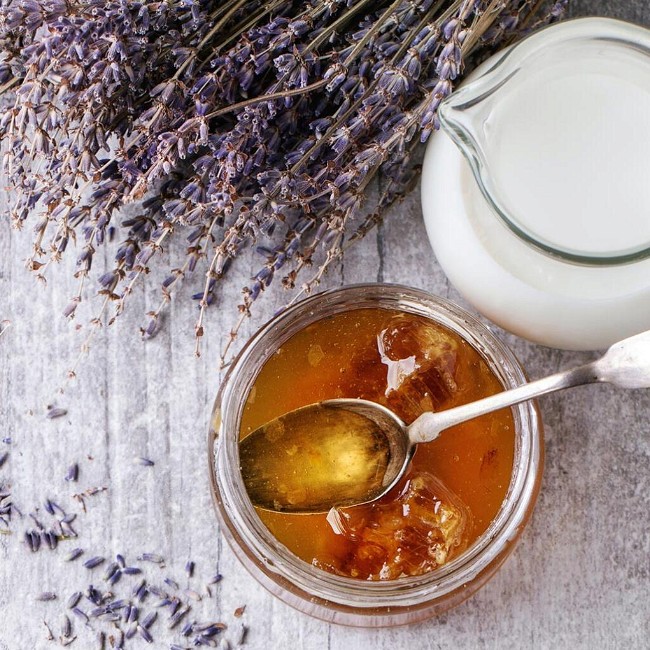




If you grow lavender — or find yourself with a jar of dried lavender buds and a good raw honey — this is the project for you. Lavender infused honey is exactly what it sounds like: raw honey steeped with dried lavender buds until the honey takes on the flower's soft, herbal fragrance and distinctive floral flavor. It takes patience (a month of steeping, mostly hands-off), but the active work comes in at well under an hour. The result keeps for months and finds its way into everything: tea, baked goods, cheese boards, glazes, and straight off the spoon.
This post walks through how to make it, which honey works best as a base, and the many ways to use it once it's ready. It's also a good excuse to talk about raw wildflower honey — which makes a beautifully complex base for this infusion, as we'll get into below.
What Is Lavender Infused Honey?
Lavender infused honey is made by steeping dried culinary lavender buds in raw honey until the honey absorbs the floral, herbaceous character of the lavender. It's different from monofloral lavender honey, which is produced when bees forage almost exclusively from lavender fields — a product that naturally carries lavender character straight from the hive. Lavender infused honey starts with any raw honey base and introduces the lavender flavor through an infusion process you control at home.
The flavor is noticeably floral — soft and herbal, with that unmistakable lavender fragrance that most people associate with the purple fields of Provence (or, in our case, the rows we grow here at Chesterhaven Beach Farm on Maryland's Eastern Shore). The sweetness of the honey carries the lavender without either flavor overwhelming the other. It's a pairing that has been used in kitchens and pantries for a very long time, and for good reason.

Choosing Your Honey Base: Where Wildflower Honey Comes In
The honey you start with shapes the final infusion more than most people expect. A very mild, neutral honey will produce a clean, purely floral result — all lavender, very little else. A honey with more character will create a more layered infusion, where the base honey's own flavor notes weave through the lavender rather than disappearing behind it.
Our raw Wildflower Honey is one of our favorite bases for this infusion. It's a polyfloral honey from Pennsylvania and Maryland — bees foraging freely across the region's native flora, producing something bold and complex, with notes of anise, black cherries, and a roasted depth that develops from late-season blooms. On its own, it's a honey with presence. Infused with lavender, the floral character of the lavender plays beautifully against that earthy, layered base. The result isn't just lavender — it's lavender with depth. For more on what makes wildflower honey different from varietal honeys, the wildflower honey guide covers it well.
If you prefer a lighter, more delicate result, our Spring Honey — harvested from our farm during the window when lavender, black locust, and fruit trees all bloom at once — already carries a natural lavender note. Infusing it adds more of what's already there. Either approach is worth trying.

Why Lavender Works So Well with Raw Honey
Lavender is one of the most versatile culinary herbs — its fragrance is immediately recognizable, and its flavor sits right at the intersection of floral, herbal, and faintly sweet. It can tip toward soapy if used too heavily, but when balanced properly, it adds a sophistication to dishes that is hard to get from anything else.
Raw honey is an ideal vehicle for lavender because honey's natural viscosity holds the infused flavors beautifully. The lavender doesn't dissolve — the honey draws out the aromatic compounds while the flower buds steep, and those compounds remain suspended in the honey long after the buds are strained out. The honey also adds a natural sweetness that softens lavender's more assertive herbal edge, making the final product genuinely pleasant to eat rather than intensely botanical.
On our farm, we grow lavender specifically because our honeybees love it. Watching the bees work the lavender rows is one of the better parts of summer — and it's part of why this infusion feels like a natural extension of what we already do here.
Food Safety First
Before we get into the recipe, a quick word on food safety, because it matters in honey infusions. Moisture is the enemy. Any water introduced into raw honey creates conditions that can allow yeast to ferment or bacteria to grow. That means every piece of equipment needs to be properly sterilized and completely dry, and the lavender buds need to be thoroughly dried as well. We outline our full process below — don't skip the drying and sterilizing steps, because those are what make the difference between a project that lasts for months and one that doesn't.

How to Make Lavender Infused Honey
This recipe makes about 192 teaspoon-sized servings from a single quart jar. The active hands-on time is under an hour, but you'll need to plan ahead for the 48-hour freeze step, the drying period, and the one-month steep. It's an excellent winter project — make a jar in November and you'll have lavender infused honey in time for the holidays.
If you'd like to experiment with honey infusions generally, working with crystallized honey is a good starting point, since it needs to be gently warmed back to liquid form anyway — which naturally fits into the infusion process. There's nothing wrong with crystallized honey; it's simply raw honey doing what raw honey does.
Step One: Sterilize Your Equipment
Run a quart-sized Ball jar (with its lid and seal) through the dishwasher on a full cycle. Clean your workspace thoroughly and disinfect all surfaces with 70% isopropyl alcohol. Wear nitrile gloves throughout. Use sterilized glass and seals for everything that will touch the honey — do not cross-contaminate your workspace.
Step Two: Prepare Your Lavender Buds
Freeze your organic dried lavender buds in a sealed container for at least 48 hours. This step removes any remote chance that insects remain in the dried buds. Remove from the freezer and spread the buds in a single thin layer over paper towels on a baking sheet. Dry completely in a dehydrator or oven set to 125°F — no moisture whatsoever can be present. Inspect the buds and remove anything that isn't lavender. Once out of the dehydrator, leave the buds loosely covered on the paper towels for an additional 24 hours before using.
Step Three: Build the Infusion
Fill the sterilized Ball jar with two full cups of the prepared dried organic lavender buds. Warm your raw honey gently until it returns to a pourable liquid state — if you're working from our raw Wildflower Honey, gentle warming in a bowl of warm water (not hot water, not microwave) works well. Be careful not to introduce any water into the jar. Slowly pour the warm honey over the lavender buds, filling the jar to the top — you'll need approximately 42–44 ounces of honey. Pour slowly to avoid trapping air bubbles.
Step Four: Steep
Seal the jar tightly. Store in a cool, dark location and do not disturb for at least one month. The honey will slowly absorb the aromatic compounds from the lavender buds during this time. Resist the urge to shake it or check on it — let it work.
Step Five: Strain and Finish
After steeping, bring a saucepan of water to a boil. Remove from heat and submerge the sealed jar about halfway into the hot water to gently warm the honey back to a pourable consistency. Remove the lid and monitor the honey temperature with a thermometer — you're aiming for 130°F. Do not let the honey exceed this temperature. Place a disinfected wire sieve lined with food-grade cheesecloth over a clean bowl and slowly pour the infused honey through it to strain out all lavender buds. Transfer the finished honey to a clean, sealed jar. It will keep at room temperature, away from light, for months.
One note: you want to avoid boiling the honey, which happens well above 130°F. Overheating changes the flavor and texture of raw honey — so low and slow is the right approach here.

Lavender Infused Honey vs. Lavender Honey
These are two different products, and it's worth knowing the difference before you shop or make a recipe recommendation to someone.
Lavender honey is a monofloral honey — produced when bees forage predominantly on lavender fields and the resulting honey naturally carries lavender character. It has a delicate floral aroma, a light amber color, and a smooth texture. It tastes like lavender because the bees collected nectar directly from lavender plants. This is harder to source and more expensive because it requires the right geography and timing.
Lavender infused honey is what this recipe makes: a raw honey base that has had lavender steeped in it. It can start from any raw honey — in our case, we love using our raw Wildflower Honey for its complexity, or our Spring Honey for its existing floral delicacy. The result is a distinctly lavender-forward honey, but one with the character of the base honey still present underneath.
Both are worth knowing. If you're curious about how honey varietals differ more broadly, this comparison of blueberry honey and wildflower honey is a good place to see how dramatically two honeys can differ even before any infusion happens.
How to Read the Label
When shopping for these products, look for clear labeling. A true lavender honey (monofloral) will typically note it is produced from lavender nectar. A lavender infused honey product will be labeled "infused" or "lavender-flavored honey." Neither is superior — they're just different products with different flavor profiles and different uses.
Evaluating Quality
For infused honey you make at home, quality is about the starting ingredients: good raw honey and high-quality, properly dried organic culinary lavender buds. For honey you buy, look for a distinct floral aroma and a texture that feels smooth and full. Natural crystallization is normal in raw honey and is a sign of minimal processing — simply warm the jar gently to restore a pourable state.

How to Use Lavender Infused Honey
This is where things get fun. Once you have a jar of lavender infused honey, you'll find yourself reaching for it constantly. Once you have your infused honey ready, there are more ways to use lavender and honey than you might expect. Here are the best uses:
In Beverages
Stirring a spoonful into hot tea is the most obvious application, and it's genuinely excellent — the honey sweetens while the lavender fragrance adds a calming, aromatic dimension. It also works beautifully stirred into iced tea, lemonade, or smoothies. Try it with our Raven Tea, which already contains fresh lavender buds, or explore the full artisanal tea collection for other natural pairings. For something spirited, lavender infused honey is also a natural substitute for plain honey in cocktails — try it anywhere our honey cocktail recipe calls for sweetener, or drop a spoonful into a flute of sparkling wine.
On a Cheese Board
This is one of the best ways to serve lavender infused honey with company. The floral notes pair particularly well with fresh chèvre, brie, and triple-crème styles — soft cheeses where lavender's delicate character can actually be tasted. With aged cheddar or blue cheese, you get more contrast, which some people prefer. For a deeper dive into pairing strategies, the honey and cheese pairing guide covers the principles well.
In Baking and Desserts
Lavender infused honey can replace plain honey or some of the sugar in a wide range of baked goods. It adds a floral note that you actually taste — this isn't subtle. It works best where the lavender is meant to be a feature, not background noise. Think honey glazes for cakes, drizzled over scones or biscuits, or stirred into whipped butter. Our Lavender Honey Lemon Cake is a natural companion recipe — worth making alongside this one. For broader technique on baking with honey, the baking with honey guide covers all the practical adjustments you need to know.
Drizzled and Finished
Don't overthink it. Lavender infused honey drizzled over yogurt, ricotta, or vanilla ice cream is simple and very good. Over sliced stone fruit — peaches, nectarines, figs — it makes an easy summer dessert. Over pancakes or waffles, it turns an ordinary breakfast into something that feels considered.
DIY Recipes at Home
Lavender infused honey lemonade is a perennial summer favorite: fresh lemon juice, lavender infused honey, and cold water. The honey balances the tartness while the lavender adds its signature floral note. A few extra lavender buds floating in the glass if you have them. It's also a great addition to sparkling water with a squeeze of lemon for something lighter.
Lavender honey glazed chicken is another worthwhile direction — marinate in lavender infused honey, garlic, soy sauce, and olive oil, then roast. The floral sweetness of the honey caramelizes beautifully against savory poultry.
For a beautiful seasonal treat, also try our Rose Infused Honey — the same technique applied to rose petals, which is lovely for spring and summer occasions.
In Skincare
A simple face mask can be made by combining lavender infused honey with plain yogurt and finely ground oats — mix to a paste, apply, leave for 15–20 minutes, rinse with warm water. Honey has a naturally conditioning texture on skin, and the lavender adds a pleasant sensory experience to the process. Our Oatmeal + Lavender Calming Dry Mask takes this idea to a finished product level if you'd prefer a ready-made version. For more on our lavender skincare line, see our full lavender body oil post, and explore the Farm to Body Sack for a curated set of our lavender-forward skincare products.

Wildflower Honey as a Honey Infusion Base
We mentioned this above, but it's worth expanding: raw wildflower honey is an excellent candidate for honey infusions in general, not just lavender. Because it's polyfloral — made from whatever was in bloom when the bees were working — it already has inherent complexity. That complexity doesn't compete with infused botanicals; it gives them more to work with.
Our Mid-Atlantic Wildflower Honey comes from beekeepers in Pennsylvania and Maryland, harvested from late-season blooms including hyssop, asters, and autumn clematis. Its deep amber color, thick texture, and layered flavor — anise, black cherries, roasted nuts — mean you get a base that adds something to the infusion rather than just carrying it. If you've only ever made lavender infused honey with a neutral honey and want to try something different, this is a worthwhile experiment.
Lavender Infused Honey FAQs
What is lavender infused honey?
It is raw honey that has been steeped with dried culinary lavender buds, allowing the honey to absorb the floral, herbaceous flavor and fragrance of lavender. It can be made at home following the recipe above or purchased as a finished product. It is different from monofloral lavender honey, which is produced naturally when bees forage on lavender fields.
How long does lavender infused honey keep?
When made properly — using fully sterilized equipment, completely dry lavender buds, and no moisture introduced at any point — lavender infused honey keeps at room temperature, away from light, for several months. Crystallization is normal and does not indicate spoilage.
What honey should I use for lavender infusion?
Any raw honey works as a base. For a bold, complex infusion with layered flavor, our raw Wildflower Honey is an excellent choice. For a lighter, more delicate floral result, our Spring Honey — which already carries lavender character from our farm — works beautifully.
What is the difference between lavender honey and lavender infused honey?
Lavender honey (monofloral) is produced when bees forage predominantly on lavender, resulting in honey that naturally carries lavender flavor. Lavender infused honey is made by steeping lavender buds in raw honey at home. Both are delicious; they have different flavor intensities and applications.
What are the best culinary uses for lavender infused honey?
Sweetening herbal teas, pairing with soft fresh cheeses, glazing cakes and scones, drizzling over yogurt and fruit, and using in cocktails and lemonade. The floral character is distinctive, so it works best where it can be tasted rather than buried in heavily spiced or chocolate-forward recipes.
Can I use lavender infused honey in baking?
Yes. Follow the same honey baking substitution guidelines as with any honey — reduce liquid slightly to account for honey's moisture content. The lavender flavor survives baking reasonably well at moderate temperatures, though some floral delicacy will soften. The baking with honey guide covers the practical adjustments.
Our Lavender Honey Lollipops are another way to enjoy the lavender-honey combination — handcrafted with dried lavender buds harvested right here at Chesterhaven Beach Farm.