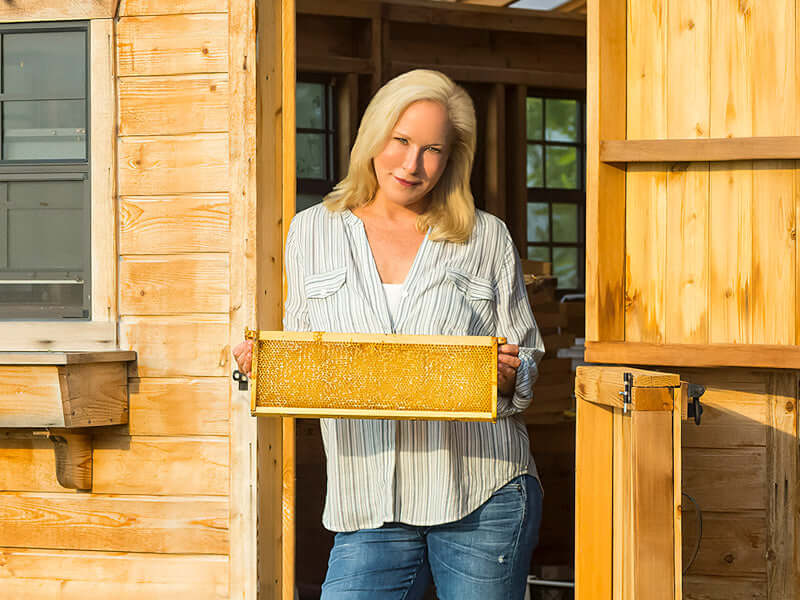


There is a category of honey that most people never get to taste. Not because it's hidden away, but because it exists on nature's terms, not anyone's production schedule. A specific flower. A specific place. A window of two or four or six weeks each year, where everything either cooperates or it doesn't. When it does, you get something extraordinary. When it doesn't, you wait until next season.
At Bee Inspired, we call these honeys Honey Royale.
The collection has eight members: five monofloral varietals sourced from beekeeper partners across North America and Spain, and three wildflower honeys harvested directly from Kara's own hives at Chesterhaven Beach Farm on Maryland's Eastern Shore. Each one is different origin, different bloom, different flavor profile, different personality. What they share is a kind of preciousness that no amount of effort or investment can manufacture. You get what the season gives you, and not one jar more.
This is the complete guide to all eight: what they taste like, where they come from, and why each one belongs in a category apart.

What Earns the Royale Designation
The designation isn't about price. It's about conditions.
A Honey Royale is a honey we can't always get. It depends on a bloom that may not cooperate, a geography that can't be replicated, or a harvest window so narrow that a single storm or late frost can eliminate the whole season's supply. There is no backup plan. There is no off-season production run. There is no way to scale a two-week bloom in a Florida swamp or a three-week harvest from a particular Maryland fall. That's also why these honeys are never discounted — the price reflects what it actually costs to produce something this specific and this scarce.
When a batch is gone, the next one waits on the season.

The Monofloral Royales
Five members of the Royale collection are monofloral honeys produced primarily from the nectar of a single flowering plant, sourced from beekeeper partners who've spent years building the relationships with the land and the bloom timing that make these honeys possible.
Tupelo, Southern Swamp Gold
Tupelo honey comes from one place: the protected wetlands of the Apalachicola River Basin in Florida's panhandle, where white tupelo gum trees bloom for roughly two weeks each spring. To harvest it, beekeepers move hives into the swamp by river barge before the bloom opens, clean every frame so no previous honey contaminates the harvest, and then wait. If a storm rolls through at the wrong moment, or flooding disrupts access, the season is over. But when everything aligns, they get tupelo.
The flavor is unlike anything in the grocery store honey aisle. Rich and buttery on the palate, with a fullness that coats the tongue and a long, gently floral finish. The sweetness is round rather than sharp, it doesn't hit and disappear. It lingers. Tupelo's unusually high fructose-to-glucose ratio means it resists crystallization indefinitely, so a jar opened in July pours the same way in February.
Color: warm amber gold, clear and luminous
Texture: slow, rich, viscous in the best sense
Best pairings: cultured butter on good bread, aged cheddar or creamy brie on a cheese board, as a finishing glaze for salmon or roasted chicken, stirred into chamomile or Earl Grey tea

Sourwood, The Appalachian Connoisseur's Choice
Outside the American South, sourwood honey is one of the best-kept secrets in the honey world. Inside it, among people who know honey seriously, it has a following that borders on obsessive. It comes from the sourwood tree (Oxydendrum arboreum), which blooms in the North Georgia highlands and Appalachian mountains for approximately three weeks in mid-summer, typically July, depending on elevation and rainfall that year.
The beekeepers who specialize in sourwood work mountain terrain to position hives during that narrow window. The yield per hive is modest. The trees grow at elevation in terrain that isn't useful for much else. All of this contributes to a honey that is genuinely rare, even within the American artisan honey market.
What surprises first-time tasters is that sourwood doesn't lead with sweetness. The entry is warm and almost spiced notes of caramel, anise, and burnt sugar that aren't harsh so much as deeply satisfying. Some people taste cinnamon. Others catch something closer to gingerbread. The floral character arrives later, and the finish has a brightness that lingers long after the spoonful is gone. Like tupelo, sourwood resists crystallization and pours smoothly year-round.
Color: pale to medium amber, sometimes with a warm reddish cast
Texture: smooth, medium-bodied, lighter than tupelo
Best pairings: warm biscuits or cornbread, sharp cheddar or aged cheese, stirred into black coffee or Earl Grey, a small pour over vanilla ice cream with toasted pecans

Fireweed, The Oregon Wildfire Bloom
Fireweed gets its name from what it does: it's one of the first plants to bloom after a wildfire, covering scorched terrain in brilliant magenta flower spikes that can stretch for miles across cleared land. Bees work these blooms intensively during the brief summer season, and what they produce has earned fireweed the informal title of "Champagne of Honeys" among varietal honey enthusiasts.
Our fireweed is sourced from Oregon, where the bloom runs through the summer months in areas of wildfire regrowth. Pure, minimally filtered, Star K Kosher certified, harvested in small quantities during a window that doesn't wait.
The flavor profile is exceptionally clean: light in color, silky smooth in texture, with a delicate buttery finish and subtle floral notes that don't announce themselves so much as simply be there. It's a honey that enhances without competing, which is exactly what you want when other flavors should still come through. For people who find most honey too heavy or too sweet, fireweed is often the one that converts them.
Color: light amber to gold
Texture: silky, lighter-bodied.
Best pairings: soft cheeses, vinaigrettes and dressings, drizzled over fresh fruit, folded into spring baked goods, anywhere you want honey's presence without its weight

Apple Blossom, Upstate New York Orchards
Apple trees in upstate New York flower for about two weeks each spring, sometimes less, if the weather doesn't cooperate, and what the bees bring back from those blossoms is something genuinely distinct. Deep amber with a hint of red, delicately floral, and mild in sweetness, apple blossom honey captures the essence of the blossom before it becomes fruit.
The harvest window is as narrow as any in the collection. Cold snaps can shorten it further. When the bloom ends, that's the season's supply, there is no second chance until the following spring. Our apple blossom honey is sourced from beekeepers who position hives directly in the orchards during peak bloom, minimally filtered, and Star K Kosher certified, making it a natural choice for the apples-and-honey tradition at Rosh Hashanah, or any time you want something clean and quietly special.
The flavor is mild and approachable: not candy-sweet, not perfumed, just a gentle floral note with a delicate depth that rewards attention.
Color: deep amber with a hint of red, richer than most light florals
Texture: smooth, easy-pouring; will crystallize over time warm gently to restore
Best pairings: stirred into tea, drizzled over oatmeal or yogurt, spread on toast, folded into apple cake or quick breads, paired with soft cheese. For Rosh Hashanah, it's the obvious choice, the honey came from the same blossoms that became the fruit
Apple Blossom Honey is a limited spring harvest. It will be available in August.

Lavender, Spain's Central Plateau
Lavender honey has a reputation problem. Because so much of what's sold under that name is a base honey steeped with dried lavender flowers, an infused product, not a true monofloral — many people have never tasted the real thing. We even have a lavender infused honey recipe for you so you can make your own, but genuine monofloral lavender honey, where bees work actual lavender fields during bloom, is a fundamentally different experience.
Ours comes from Spain's central plateau, where Lavandula angustifolia and Lavandula latifolia grow across the dry limestone meseta in late May and early June. The bloom window is two to four weeks. The bees work the fields during that narrow stretch, and what they produce is the quietest member of the Royale collection and, in some ways, the most elegant.
Where tupelo is full and buttery, and sourwood is warm and spiced, Spanish lavender honey is restrained and precise. Pale, almost translucent. On the nose, it's fresh lavender — clean and herbal, closer to standing at the edge of a field than anything you'd find in a candle shop. The first impression on the palate is buttery smoothness, and then the lavender arrives, gentle and woven in rather than announced. A brightness lifts the finish — something citrus-adjacent, like lemon zest or a light bergamot — that gives it a long, clean ending.
It is measurably less sweet than the other Royales. For people who find most honeys too sweet to eat on their own, this is often the one that turns them into serious honey people.
Color: pale gold, yellow
Texture: silky, lighter-bodied
Best pairings: Manchego or triple-cream brie on a cheese board, stirred cold into chamomile or Earl Grey, in a Bee's Knees cocktail, on bread with cultured butter

The Farm Royales — From Kara's Own Hives
Three members of the Honey Royale collection are in a category entirely their own: wildflower honeys harvested directly from the hives at Chesterhaven Beach Farm on Maryland's Eastern Shore, where Kara Brook Brown manages a hundred acres and an apiary that produces something different with every season. These aren't sourced through a network of partners. They're Kara's bees, on Kara's land, during Kara's harvest.
Because they're polyfloral, the bees forage freely across whatever is blooming on the farm, the flavor shifts from season to season and year to year. That variability is the point. Each jar of a Farm Royale is a specific moment in time at a specific place, and it will taste slightly different from the jar harvested the season before. No two are ever exactly alike.
Spring Honey — When the Farm Wakes Up
There's a three-week window each spring when Chesterhaven Beach Farm decides to show off. Black locust trees, wildflowers, fruit blossoms, lavender — it all opens at once, and the bees go into overdrive. What they collect during that brief explosion of bloom becomes Spring Honey: bright, floral, and alive in a way that's genuinely hard to describe until you taste it.
The flavor is light and clean, with a fresh sweetness that doesn't overpower whatever you pair it with. It's the most versatile honey in the Farm Royale trio — the one that works equally well stirred into vinaigrette, drizzled over a cheese wedge, swirled into yogurt, or eaten straight from a spoon standing at the kitchen counter.
Color: bright amber
Texture: smooth, easy-pouring; will slowly crystallize as all minimally filtered honey does, simply remove the lid and place the jar in a sauce pan of warm water to gently restore
Best pairings: aged cheddar or blue cheese, Greek yogurt with fresh fruit, chamomile or lavender tea, warm biscuits or scones, vinaigrettes with bitter greens

Summer Honey — The Rarest of All
Summer Honey is the most rare offering in the entire Royale collection. Kara's farm on the Eastern Shore went nearly ten years without a summer harvest — the season has to produce a bumper bloom of wildflowers and clover, the timing has to cooperate, and everything depends on the weather. When it happens, it's unexpected. When it's gone, it's gone until the farm delivers another.
The flavor reflects high summer on the Eastern Shore: brightly floral, sweet, and pollen-forward, with a hint of caramel in the finish. It's warmer and fuller-bodied than Spring Honey — richer, deeper, with more presence on the palate. Exclusively available from Bee Inspired, because it only exists when Kara's farm makes it.
Color: golden, full and warm
Texture: smooth, light to medium-bodied; may crystallize over time
Best pairings: Greek yogurt with fruit and nuts, drizzled over roasted stone fruit, stirred into hot tea, or — if you're lucky enough to have a jar — eaten from a spoon with nothing competing
Summer Honey is an extremely limited harvest, produced only when conditions align.

Autumn Honey — The Late Season Underdog
Spring honey gets most of the attention. Autumn Honey earns it quietly, from a different direction.
After the rest of the farm has wound down, a particular group of plants is still standing: goldenrod, aster, sunflower, buckwheat — the scrappy late-season survivors that keep producing nectar into September and October. The bees that work these blooms produce something that looks and tastes nothing like what came out of the hive in May. Dark, almost mahogany in color. Thick and rich in texture. Bold and earthy in flavor, with a robustness that holds up to strong pairings the spring and summer honeys can't quite match.
Like sourwood and tupelo, Autumn Honey resists crystallization and stays liquid year-round. Every jar comes from one farm — Kara's hives, her late-season flowers, her harvest timing. It's the honey that makes coffee drinkers stop adding sugar and cheese lovers reconsider their boards.
Color: dark amber, deep mahogany.
Texture: thick, slow-pouring, richly viscous.
Best pairings: black coffee, dark tea, aged or sharp cheese, cornbread, bold autumn dishes that can absorb its character.

How to Taste Them: A Suggested Order
If you want to understand what sets these honeys apart from one another — and from everything else — tasting them in sequence is the most instructive thing you can do. Starting with the most delicate lets your palate read its subtlety before bolder flavors arrive. This order works well when you have several jars open at once, and makes for a genuinely memorable experience if you're hosting.
Start with the Lavender from Spain. Its restraint and pale sweetness read best on a fresh palate. Give it a moment before moving on.
Move to Fireweed. Clean and buttery, it contrasts with the lavender's herbal quality and starts to define what "delicate" means in varietal honey terms.
Then Apple Blossom — similar lightness to fireweed, but with a deeper amber color and a floral note that reads as distinctly fruit-adjacent.
Tupelo comes next. After the lighter honeys, its richness and fullness become immediately apparent. This is where buttery weight makes itself known.
Move to Spring Honey from the Farm Royales. Its bright, fresh floral character contrasts well with tupelo's settled richness — the contrast makes both more legible.
Then Sourwood, which will announce itself clearly: the caramel-spice complexity hits differently after everything that came before it.
If Summer Honey is available, taste it here — it bridges the floral warmth of Spring with the deeper tones ahead.
Finish with Autumn Honey. Its dark, mahogany richness is the natural conclusion — the boldest and most complex of the Farm Royales.
Between each honey, a plain water cracker or a small piece of neutral bread will clear the palate without introducing competing flavors. Skip anything salted, seasoned, or strongly flavored. If you're serving this as a proper honey tasting for guests, small ceramic or wooden spoons and individual saucers make the experience feel considered. Label each jar — people will want to know what they're tasting before the second spoonful.
Want to go deeper on the technique? Our complete guide to honey tasting walks through sensory evaluation the way a sommelier would.

On Collecting the Full Set
A number of our customers keep multiple Royales in the pantry at the same time, reaching for different ones depending on what the moment calls for. The monofloral trio — tupelo, sourwood, fireweed — for weekday moments: tea in the morning, a cheese course after dinner, a drizzle into salad dressing. The Farm Royales — spring, autumn, and summer when it exists — as a record of the season, a connection to a specific piece of land and a particular year's weather. The lavender and apple blossom for guests who already think they know honey and deserve to be surprised.
Together, they cover more flavor territory than most people expect from eight jars of anything.
If you're shopping for someone who takes food seriously, the Honey Royale Gift Set is the most certain gift we know. Someone who has tasted real tupelo once will understand immediately what you're giving them — and someone who hasn't tasted any of these yet is about to have their first genuinely unexpected honey experience.
Explore More of the Royale World
If this guide sent you further down the honey rabbit hole, here are a few places to keep going:
- Sourwood vs. Tupelo: A Side-by-Side Comparison — a deeper look at the two honeys most people encounter first in the collection
- What Is Sourwood Honey? — the full story on the Appalachian connoisseur's choice
- What Is Tupelo Honey? — origin, flavor, rarity, and how to use the most famous of the Royales
- What Is Monofloral Honey? — the science and craft behind single-origin varietal honey
- How to Taste Honey Like a Sommelier — a complete sensory guide for approaching honey tasting with intention
- What is Lavender Honey? True lavender honey is made by bees from lavender nectar, not by infusion.